
Rising Waters, Lingering Worries: Kashmir’s Flood Defences Face Another Test
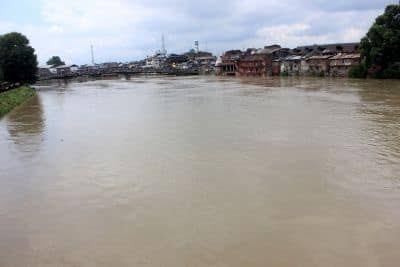
Jhelum remains below flood mark despite relentless rain, but urban waterlogging exposes glaring gaps in preparedness
Experts call for wetland restoration, drainage overhaul and climate-resilient planning as extreme weather events intensify
Srinagar: The continuous spell of heavy rainfall across Kashmir has once again put the Valley’s flood preparedness under scrutiny. Although the Jhelum and its tributaries continue to flow well below danger levels, widespread waterlogging in Srinagar and several other districts has exposed persistent shortcomings in urban drainage and flood management, reviving concerns over Kashmir’s ability to cope with future extreme weather events.
According to the latest gauge readings issued by the Irrigation and Flood Control (I&FC) Department, the Jhelum was flowing at 18.79 feet at Sangam, against the flood declaration level of 21 feet. At Ram Munshi Bagh, the river stood at 16.11 feet, below the warning level of 18 feet, while Asham recorded 9.32 feet, comfortably below its warning mark of 14 feet. Officials have maintained that there is no immediate flood threat and that the river system remains under constant surveillance.
Despite the reassuring river levels, heavy rain inundated roads, residential colonies and low-lying areas across Srinagar, including Bemina, Rajbagh, Mehjoor Nagar, Nowgam, Hyderpora and parts of Downtown. Similar scenes were witnessed in south Kashmir, where overflowing drains, inundated paddy fields and waterlogged roads disrupted normal life.
Residents said the situation has become routine whenever the Valley experiences prolonged rainfall.
“Every time it rains for a few hours, our lane turns into a pond. Water enters our compound and drains remain clogged for days. We keep hearing claims about flood preparedness, but on the ground nothing seems to have changed,” said Mohammad Yousuf, a resident of Bemina.
Another resident, Shabir Ahmad of Rajbagh, criticised the administration for failing to address recurring drainage issues.
“The government talks about major flood mitigation projects, but basic drainage in the city remains neglected. Even moderate rainfall leaves roads submerged and makes commuting a nightmare. If this is the situation now, people fear what will happen during a major flood,” he said.
Experts say the recurring flooding of urban localities even when the Jhelum remains below the warning mark underlines a deeper problem.
“The challenge today is no longer confined to the river alone. Much of the flooding is now caused by inadequate drainage infrastructure, blocked channels, rapid urbanisation and the shrinking of wetlands that once acted as natural flood reservoirs,” an environmental expert said.
The catastrophic floods of September 2014 had prompted massive investments in strengthening Kashmir’s flood management system. The government initiated dredging of the Jhelum, strengthened embankments, upgraded pumping stations and proposed restoration of flood spill channels and wetlands.
While these measures have significantly enhanced the river’s carrying capacity, experts believe much remains to be done.
Many of the Valley’s wetlands, including Hokersar, Wular, Hygam and Anchar, continue to shrink due to encroachments, pollution and unplanned development. Their declining capacity to absorb excess rainwater has increased the vulnerability of urban areas to flooding.
Scientists have also warned that climate change is altering rainfall patterns in the Himalayas. Instead of prolonged moderate rainfall, Kashmir is increasingly witnessing short-duration but high-intensity downpours capable of overwhelming drainage systems within hours. The recent cloudbursts and flash floods in Rajouri, Poonch and other parts of Jammu have reinforced these concerns.
Urban planners argue that future flood mitigation must move beyond river management alone. They advocate comprehensive restoration of wetlands, scientific desilting of drainage channels, expansion of storm-water drainage networks, strict action against encroachments, regular maintenance of pumping stations and climate-resilient urban planning to reduce flood risks.
Although the latest gauge readings indicate that the Jhelum remains safely below flood levels and there is no immediate cause for alarm, every spell of heavy rain continues to reveal the Valley’s vulnerabilities.
Twelve years after the devastating 2014 floods, Kashmir has undoubtedly strengthened parts of its flood defence network, but recurring urban inundation serves as a reminder that the challenge of managing water has evolved. As climate change increases the frequency of extreme weather events, experts warn that unless long-pending gaps in drainage, wetland conservation and urban planning are addressed, even moderate rainfall could continue to bring large parts of the Valley to a standstill.
