
J&K’s Green Gold Under Pressure as Forests Face Climate, Concrete & Human Footprint
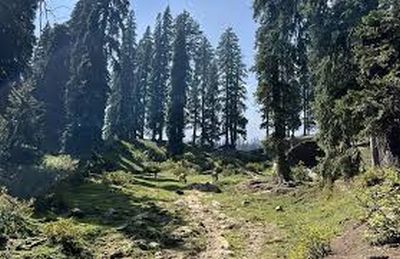
While official data shows an increase in forest cover, experts warn that dense forests are thinning and fragile ecosystems are under growing stress
From Pir Panjal to Kashmir Valley, deforestation, encroachments and changing climate are reshaping Jammu and Kashmir’s forests
Our Special Correspondent
Srinagar: The forests of Jammu and Kashmir have long been the region’s silent guardians. Stretching from the deodar-covered slopes of the Pir Panjal to the alpine forests of Gurez and the coniferous belts of Chenab Valley, these green expanses have protected watersheds, regulated temperatures, nurtured biodiversity and sustained the livelihoods of thousands of families.
But beneath the canopy, scientists say, the forests are changing.
The latest forest assessments present a paradox. Official figures show that Jammu and Kashmir’s overall forest cover has increased over the past decade, yet experts caution that dense forests are gradually giving way to thinner and fragmented landscapes increasingly vulnerable to climate change and human pressure.
According to the latest India State of Forest Report, Jammu and Kashmir today has a forest cover of 21,346 square kilometres, accounting for about 39 per cent of its geographical area. When tree cover is included, nearly 48 per cent of the Union Territory falls under green cover, among the highest proportions in the country.
The figures represent an increase of nearly 398 square kilometres of forest cover over the past decade and a gain of around 84 square kilometres between 2021 and 2023 alone, reflecting plantation drives, habitat restoration projects and natural regeneration in some areas.
Yet the numbers tell only part of the story.
Of the total forest cover, only about 4,209 square kilometres qualify as very dense forests, while the largest share consists of open forests with thinning canopies and degraded vegetation. Scientists warn that the quality of forests matters as much as their quantity.
“An increase in forest cover does not necessarily mean an increase in healthy forests,” says noted earth scientist Prof. Shakil Ahmad Romshoo.
“The Himalayan ecosystems are experiencing unprecedented pressures from climate change, land use change and human activities. Fragmentation of forests can have serious implications for biodiversity, water resources and disaster resilience,” he says.
The forests of Jammu and Kashmir are home to iconic species such as the Hangul, Himalayan black bear, musk deer, leopard and snow leopard, many of which are increasingly losing habitat due to shrinking forest corridors and expanding human settlements.
Scientists from the University of Kashmir have repeatedly warned that rising temperatures, declining snowfall and prolonged dry spells are altering forest ecosystems across the western Himalayas.
The warning signs are already visible.
The prolonged dry winter of 2025, which witnessed nearly an 80 per cent precipitation deficit, triggered fears of widespread forest fires and moisture stress across many forest divisions in Kashmir.
Experts say warming temperatures are pushing tree lines higher into alpine regions while changing the composition of vegetation in lower elevations.
Dr Irfan Rashid, a noted glaciologist and environmental scientist from the University of Kashmir, says the impacts of climate change are becoming increasingly visible across Himalayan ecosystems.
“Forests, glaciers, wetlands and rivers are interconnected systems. Changes in one component inevitably affect the others. Rising temperatures and declining snow cover are already altering ecological processes across Kashmir,” he says.
Encroachments and infrastructure expansion have added to the pressure.
Road widening projects, hydropower construction, urban expansion and illegal felling continue to fragment forest habitats across parts of Jammu and Kashmir, particularly in ecologically sensitive mountain areas.
Last year, the Supreme Court observed that illegal tree felling and forest degradation may have contributed to the scale of devastation caused by floods and landslides across Himalayan states including Jammu and Kashmir.
Conservationists argue that protecting forests is no longer merely an environmental issue but an economic and social necessity.
The forests of Jammu and Kashmir feed rivers that irrigate orchards and paddy fields, recharge springs and wetlands, stabilise mountain slopes and act as natural barriers against landslides and flash floods.
As cloudbursts, extreme rainfall events and prolonged dry spells become increasingly frequent, experts believe healthy forests may prove to be among the region’s most important climate defences.
For generations, Kashmiris referred to forests as their “green gold”.
The challenge before Jammu and Kashmir now is not merely to increase forest cover on paper, but to ensure that the forests standing on its mountains remain healthy, connected and alive for generations to come.
