
CLIMATE CHANGE : Thajwas loses 88% ice volume as Kashmir’s glaciers melt at alarming pace
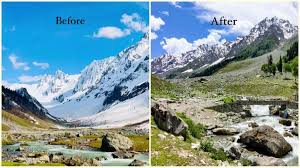
Scientists warn rising temperatures and declining snowfall are rapidly shrinking the iconic Sonamarg glacier
Experts fear glacier retreat could trigger long-term threats to Kashmir’s water security, tourism and fragile ecology
Our Special Correspondent
Srinagar: The majestic Thajwas Glacier in Sonamarg, once regarded as one of Kashmir’s most enduring symbols of snow-clad beauty, is melting at an alarming pace, triggering fresh concerns among scientists and environmentalists over the growing impact of climate change on the fragile Himalayan ecosystem.
Nestled beneath the towering peaks of Sonamarg, the glacier for decades remained a major attraction for tourists who would walk across thick sheets of snow even during peak summer months. Fed by centuries-old ice accumulation, Thajwas was not merely a scenic destination but also a vital natural reservoir sustaining streams and water channels flowing into different parts of the Valley. Today, however, the glacier bears visible scars of climate change, with vast stretches of exposed rock replacing what was once a continuous blanket of ice and snow.
Recent scientific studies have revealed a deeply worrying trend. Researchers studying the glacier have found that Thajwas has lost nearly 88 per cent of its ice volume over time, while its overall geographical spread has reduced drastically over the decades. Another assessment has warned that the glacier is rapidly retreating due to increasing temperatures, reduced snowfall and prolonged dry spells across the Himalayas. Scientists say the glacier’s decline is part of a wider pattern affecting glaciers throughout Jammu and Kashmir, many of which are shrinking faster than previously estimated.
Experts attribute the rapid melting to multiple climate-linked factors, including rising average temperatures, erratic precipitation patterns, black carbon deposits and declining winter snowfall. In recent years, Kashmir has witnessed unusually warm winters, with snowfall arriving late and melting earlier than normal. Climate scientists say these shifts are disrupting the delicate balance needed for glacier survival in the higher reaches of the Himalayas.
Noted earth scientist Shakil Ahmad Romshoo has repeatedly warned that Himalayan glaciers are extremely sensitive to even small changes in temperature and their continued retreat could have serious consequences for Kashmir’s long-term water security. According to experts, glaciers act as natural “water towers,” gradually releasing meltwater during summer months and sustaining rivers, streams and agricultural fields across the Valley. Their depletion could eventually impact irrigation systems, hydropower generation and drinking water availability.
Officials in the Meteorological Department have also observed significant shifts in weather behaviour across Jammu and Kashmir over recent years. Reduced snow accumulation, warmer winter temperatures and a rise in extreme weather events such as cloudbursts, flash floods and intense rainfall have increasingly become common across the region. Environmentalists say these changing patterns are directly linked to global climate change and are accelerating glacier retreat in the Himalayas.
For residents of Sonamarg, the glacier’s disappearance is no longer hidden in research papers but is unfolding before their eyes with every passing season. Elderly locals recall a time when snow from Thajwas extended far down the mountains and remained intact well into late summer. Pony owners and tourism workers say the glacier has visibly receded over the past two decades, forcing tourists to travel farther uphill to witness the remaining snow patches.
“Earlier tourists would step onto snow within minutes, but now they have to climb much higher because the glacier keeps shrinking every year,” said a local tourism operator in Sonamarg.
Environmental experts warn that beyond tourism and aesthetics, the melting of glaciers poses a major ecological challenge for Kashmir. Shrinking glaciers could alter river flows, destabilise mountain slopes and affect biodiversity in high-altitude regions. Scientists believe that unless global emissions are reduced and stronger climate adaptation measures are adopted, glaciers like Thajwas may continue to retreat rapidly in the coming decades.
As the famed glacier slowly disappears into the mountains, Thajwas now stands as both a fading natural wonder and a powerful warning from the Himalayas — that climate change is no longer a distant threat, but a reality already reshaping Kashmir’s landscape, weather and future
