
Weather Uncertainty Drives Kashmir Farmers Towards Lavender Cultivation
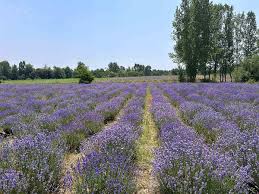
Changing rainfall patterns, shrinking yields push growers away from traditional crops
Officials say ‘Purple Revolution’ offering climate-resilient and high-value farming alternative
Srinaga: As unpredictable weather continues to disrupt traditional farming in Kashmir, an increasing number of cultivators are switching to lavender farming, banking on the aromatic crop’s low water requirement and higher market value to offset climate-related losses.
From Budgam and Pulwama to Kupwara and Ganderbal, farmers are steadily replacing maize and other conventional crops with lavender, particularly in rain-fed belts where erratic rainfall and prolonged dry spells have severely impacted productivity.
“We have never seen weather behave like this before. Rainfall patterns have completely changed over the last few years,” said Abdul Rashid, a farmer from Beerwah in Budgam. “Traditional crops are failing repeatedly, but lavender survives even during dry conditions and gives us decent income.”
Ghulam Mohammad, another farmer from Khag, said frequent weather fluctuations had made conventional agriculture financially risky. “Sometimes there is drought during sowing season and sometimes heavy rain destroys standing crops. Lavender is comparatively safer and requires less irrigation,” he said.
In Pulwama, farmer Shabir Ahmad said the rising cost of farming inputs coupled with uncertain weather had forced many growers to explore alternatives. “Earlier we cultivated maize and vegetables, but returns kept falling. Now many farmers are moving towards lavender because oil extraction gives better profits,” he said.
Officials from the CSIR–Indian Institute of Integrative Medicine (IIIM), which is implementing the Aroma Mission in Jammu and Kashmir, said climate resilience is a major reason behind the rapid expansion of lavender cultivation in the Valley.
“Lavender has emerged as a suitable crop for areas facing water stress and climatic uncertainty,” a senior IIIM official said. “It requires relatively less water, adapts well to hilly terrain and offers farmers multiple income opportunities through oil extraction and value-added products.”
An agriculture department official said farmers cultivating lavender on marginal land are earning significantly more than they did from traditional crops. “The crop has shown encouraging results in rain-fed areas where farmers earlier struggled with low productivity. More growers are now approaching the department for training and seedlings,” the official said.
Experts say Kashmir’s agriculture sector is increasingly bearing the brunt of climate change, including reduced snowfall, warmer winters, untimely rains and rising temperatures that are disturbing sowing and harvesting cycles.
“Climate variability is forcing farmers to diversify towards crops that can withstand moisture stress,” said an agriculture scientist associated with the programme. “Lavender is proving to be both economically viable and environmentally sustainable.”
Officials believe the Valley’s growing “Purple Revolution” could become a long-term alternative livelihood model for farmers grappling with weather-induced losses and declining returns from conventional agriculture.
