
Kashmir’s paddy fields shrink as farmers abandon staple crop
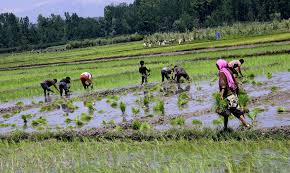
Declining acreage, erratic weather and urbanisation reshape Valley’s agrarian landscape
Growers warn “paddy is no longer sustainable”
Our Special Correspondent
Srinagar: The vast stretches of paddy fields that once formed the backbone of Kashmir’s rural economy are steadily shrinking, with both official data and ground reports indicating a sustained decline in rice cultivation across the Valley.
According to agriculture department figures, the area under paddy in Jammu and Kashmir has fallen from over 1.6 lakh hectares a decade ago to around 1.4 lakh hectares in recent years. Production has also seen fluctuations, largely due to erratic weather patterns, declining water availability and shrinking cultivable land.
Rice remains the staple food of the Valley, traditionally cultivated in districts such as Anantnag, Pulwama, Budgam, Baramulla and parts of Ganderbal. However, increasing urban expansion and changing economic priorities have led to large-scale conversion of fertile paddy land into residential colonies, commercial spaces and, in some cases, orchards.
“We grew paddy on all our land earlier, but now much of it has been sold or converted,” said a farmer from Budgam. “The returns are low compared to the effort. Labour costs have gone up, and water is no longer reliable.”
Farmers across south Kashmir echoed similar concerns, particularly over irrigation. Many said traditional canal systems, once sustained by steady snowfall and glacial melt, are no longer dependable.
“In the past, water would reach our fields on time. Now, sometimes canals run dry during the crucial growing period,” said a farmer from Pulwama. “Without water, paddy farming becomes a risk we cannot afford.”
Climate variability has further compounded the problem. Untimely rains, prolonged dry spells and rising temperatures have disrupted the traditional sowing and harvesting cycles, reducing both yield and predictability.
In north Kashmir’s Baramulla district, a farmer said the shift away from paddy is becoming irreversible. “People are moving to horticulture or leaving land idle. Paddy requires more effort and gives less return. It is slowly disappearing.”
Experts warn that the decline in paddy cultivation could have serious implications for the region’s food security. Kashmir already relies heavily on rice imports from other parts of India, and any further drop in local production could deepen that dependence.
Officials acknowledge the trend but say interventions are underway to arrest the decline. “The government is focusing on promoting high-yielding seed varieties, mechanisation and better irrigation facilities,” an agriculture department official said. “We are also working to discourage the conversion of agricultural land.”
However, enforcement of land-use regulations remains a challenge, particularly in rapidly expanding urban areas.
On the ground, farmers remain unconvinced. “There is support on paper, but not enough on the field,” said a farmer from Anantnag. “If things continue like this, future generations will not even know how paddy was grown here.”
As the sowing season approaches, the Valley’s iconic paddy fields stand at a crossroads—caught between economic pressures, environmental change and policy gaps—raising questions about the future of Kashmir’s most essential crop.
