
The students break down
Dr. Satyavan Saurabh
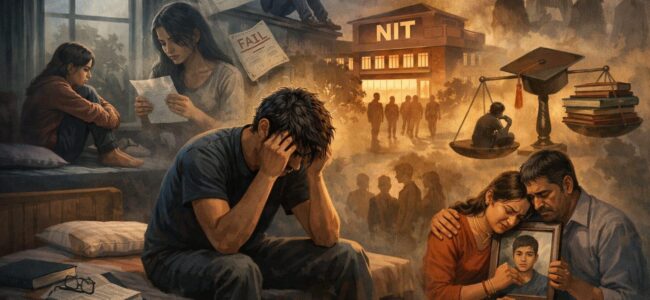
Prestigious Indian technical education institutions, once known as “dream factories,” are now becoming factories of mental stress for many young people. The suicides of four students within just two months at the National Institute of Technology, Kurukshetra, Haryana, have shocked the entire nation. This is not just the end of four lives, but the failure of a system that is destroying talent instead of nurturing it. These incidents, which occurred between February and April 2026, are not isolated incidents but indicate a dangerous chain—one incident follows another, as despair spreads from one person to the next. Diksha Dubey’s suicide note—”I could not achieve anything”—is not just the anguish of one student, but a reflection of a mindset in which achieving something has become the ultimate goal of life.
In India, exams like JEE Mains and JEE Advanced have long been considered the key to success. Millions of students work tirelessly for years to crack these exams and gain admission to institutions like the National Institute of Technology, Kurukshetra.
But ironically, admission to an institution, considered a life’s greatest achievement, becomes a battleground for many students. Once there, students must not only excel academically but also face the pressure of proving themselves on every front. The 75% attendance rule, constant assignments and projects, the stress of semester exams, and the uncertainty of placements—all of these add up to an invisible but heavy burden on students’ minds.
This pressure isn’t just academic, but also psychological and social. When a student who has been at the top of their school or coaching class suddenly finds themselves among hundreds of talented students, their self-image is affected.
Where they once considered themselves “the best,” they now feel “average” or, at times, “weak.” This change is mentally very difficult for many students. They are unable to accept their failures and gradually become victims of self-doubt and inferiority complex.
The role of the family is also crucial in this entire crisis. In Indian society, education is linked to social prestige. Parents have high expectations for their children, and this expectation often inadvertently turns into pressure. National Crime Records Bureau data shows that family pressure is a major factor in suicides among youth.
This pressure is especially acute for students from economically disadvantaged backgrounds. Their parents spend a significant portion of their limited income on their education and expect success in return. Therefore, if a student fails to perform as expected for any reason, they feel they have let down not only themselves but their entire family.
Social media has further complicated this situation. Today’s youth are constantly surrounded by glimpses of others’ “success” and “happy lives.” The glitz and glamour displayed on Instagram, YouTube, and other platforms creates a world far removed from reality. However, students begin to compare themselves to others, believing it to be real. When they feel they fall short of this “ideal life,” dissatisfaction and frustration grow within them.
French sociologist Emile Durkheim viewed suicide not just as an individual problem, but as a social one. His theory of “anomic suicide” suggests that when societal norms and expectations become unclear or unbalanced, individuals begin to feel isolated. This same situation is evident in many technical institutions today. Students are placed in an environment where high expectations are placed on them, but they lack adequate emotional or social support. As a result, they begin to break down internally.
This problem is even more acute for students from rural backgrounds. They are suddenly thrust into an environment where the language, lifestyle, and social behavior are all different. They find it difficult to connect with those around them. This isolation gradually turns into isolation, and loneliness can become a major threat to mental health. Many students are unable to share their problems with anyone because they feel that doing so is a sign of weakness.
For female students, this struggle occurs on many levels. They have to balance academics with safety, social expectations, and self-reliance. Often, they are made to feel like they have to “prove” themselves, not only as students but also as women. This dual pressure further impacts their mental health.
Many shortcomings also emerge at the institutional level. Mental health services are inadequate in most technical institutions. One or two counselors are not enough to handle the problems of hundreds of students. Students are often hesitant to seek counseling because they fear it will affect their image. Furthermore, mentorship systems are often ineffective. In some cases, instead of being helpful, they cause additional stress for students.
The steps taken by the administration following the four suicides—such as forming an inquiry committee, improving counseling services, and declaring holidays—are important, but not sufficient. This problem will not be solved by immediate measures alone. It requires long-term and comprehensive change. The education system must recognize that students are not just marks and ranks, but human beings with emotional and social needs.
The solution must prioritize mental health. Every institution should have adequate numbers of trained counselors, and students should be encouraged to use their services without fear or embarrassment. Furthermore, flexibility in academic regulations is essential. Not every student is the same, and it is unfair to expect everyone to perform equally.
Families also need to shift their mindset. They must understand that success isn’t just about a high salary or a prestigious job. Prioritizing children’s mental health and well-being is just as important. Parents should communicate openly with their children and reassure them that they are there for them no matter what.
A positive and supportive environment needs to be created at the campus level as well. Students should be encouraged to help each other and share their problems. Initiatives such as peer support groups, cultural activities, and sports can help improve students’ mental health.
These events at the National Institute of Technology, Kurukshetra, are not just a problem for one institution, but a warning to the entire Indian education system. If timely attention is not addressed, this crisis could deepen. It is essential that we take this issue seriously and work together to find solutions that not only ensure students’ academic development but also protect their mental and emotional health.
Students are the future of the country, and if that future crumbles under the weight of frustration and pressure, it’s not just a personal tragedy, but a national crisis. It’s time to redefine success and build an education system that empowers students to be not only successful but also balanced and happy human beings.
(The author is a PhD in Political Science. He is a regular contributor to various publications)
