
Kashmir’s women farmers rise as a new face of rural economy
Government support, modern techniques and resilience drive a quiet agricultural transformation
Our Special Correspondent
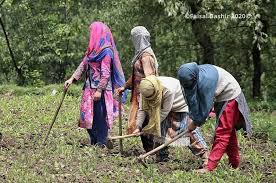
Srinagar: In the quiet farmlands of Kashmir, a silent transformation is taking root. Across paddy fields, orchards, and vegetable gardens, women are stepping beyond traditional roles to become key drivers of the Valley’s agricultural economy—sowing not just crops, but resilience, independence, and change.
From early morning till dusk, women can be seen tending to saffron fields in Pampore, managing apple orchards in Shopian, and cultivating vegetables in Budgam and Ganderbal.
For decades, they have been the backbone of farming in Kashmir, often working behind the scenes. Today, their contribution is gaining long-overdue recognition, backed by targeted government support and schemes aimed at strengthening their role.
With the government focusing on inclusive growth, several initiatives have been rolled out to empower women farmers through training, financial assistance, and access to modern techniques. Self-help groups (SHGs) have emerged as a powerful tool, enabling women to pool resources, access credit, and market their produce more effectively.
Agriculture Minister Javaid Dar emphasized the importance of women in the sector, stating, “Women are the backbone of agriculture in Jammu and Kashmir. Their contribution is immense, and the government is committed to empowering them with resources, training, and financial support to enhance productivity and ensure sustainable livelihoods.”
On the ground, the impact of these efforts is visible in the voices of women farmers themselves.
“We have always worked in the fields, but now we are being recognized and supported. With training and financial help, we are able to earn more and support our families,” said Rafiqa Bano, a vegetable grower from Budgam.
Shabnam Akhter, who manages an apple orchard in Shopian, said the shift has been empowering. “Earlier, we depended on others to sell our produce. Now, we are directly involved in marketing and decision-making. It has given us confidence and independence.”
In Pampore, where saffron cultivation is a way of life, another farmer shared a similar sentiment. “Government schemes and awareness programs have helped us improve our yield. We are learning new techniques that are making a real difference,” said Naseema, a saffron cultivator.
The introduction of high-density plantation, polyhouse farming, and organic cultivation has opened new avenues for women. In many areas, women are now leading farmer producer organizations (FPOs), engaging in value addition, packaging, and direct marketing—steps that are helping them move up the agricultural value chain.
In districts like Anantnag and Kulgam, women-led initiatives in mushroom cultivation and dairy farming are not only boosting household incomes but also creating employment opportunities within communities. Their growing involvement in decision-making—both at the farm and household level—is gradually reshaping social dynamics in rural Kashmir.
Despite challenges such as limited land ownership, access to markets, and climate uncertainties, these women continue to push boundaries. Their determination, coupled with institutional support, is laying the foundation for a more inclusive and sustainable agricultural future.
As Kashmir’s fields bloom with each passing season, they tell a story of strength and transformation—where women are no longer just contributors, but leaders of change, nurturing not only crops but the future of the Valley’s agrarian economy.
