
Golden Fields of Pulwama, south Kashmir District Leads J&K’s Yellow Revolution
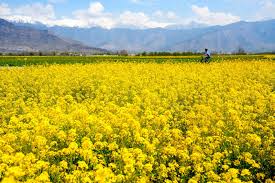
From mustard blooms to oilseed prosperity, Pulwama emerges as the torchbearer of agricultural transformation in the Valley
Sanah Wani
Pulwama: Bathed in a sea of golden mustard flowers, the fields of Pulwama have become a striking symbol of Jammu and Kashmir’s growing “Yellow Revolution,” with the south Kashmir district emerging as a frontrunner in oilseed cultivation and farmer-led agricultural transformation.
Traditionally known for its paddy and apple production, Pulwama is now witnessing a remarkable shift as hundreds of farmers embrace mustard cultivation, driven by favourable government policies, improved seed varieties, and rising demand for edible oils. Vast stretches of land that once lay fallow during the Rabi season are today alive with vibrant yellow blooms, signalling both ecological renewal and economic promise.
Officials from the Agriculture Department credit this success to sustained awareness campaigns and targeted interventions under various centrally sponsored schemes.
“Pulwama has shown exceptional progress in oilseed cultivation over the past few years. The acreage under mustard has expanded significantly, and farmers are realising better returns compared to traditional crops,” said Chief Agriculture Officer Pulwama.
He added that the department has been providing high-yielding seed varieties, technical guidance, and timely inputs to farmers, ensuring higher productivity and better quality produce.
“The Yellow Revolution is not just about increasing production but about making farming more sustainable and profitable,” he noted.
Director Agriculture Kashmir, Sartaj Ahmad Shah, said Pulwama’s success story is being replicated in other districts as well. “Pulwama has set an example for the entire Valley. Our aim is to expand oilseed cultivation across Jammu and Kashmir to reduce imports and strengthen the rural economy,” he said.
He further emphasised the economic potential of oilseed cultivation, stating, “Mustard farming is proving to be a game-changer for small and marginal farmers. It not only supplements their income but also fits well into our crop diversification strategy.”
An Agriculture Extension Officer in Pulwama highlighted the growing farmer participation.
“There has been a visible shift in mindset. Farmers are now more open to adopting alternative crops like mustard, especially after witnessing successful demonstrations in their own villages,” he said.
Farmers in the district echo this optimism. Many say mustard requires less water and fewer inputs, making it an ideal crop amid changing climatic patterns. “Earlier, our land would remain unused in winter. Now, mustard has given us an additional source of income,” said a farmer from Kakapora.
Another farmer from Pampore said, “The government’s support in terms of seeds and guidance has made a big difference. We are hopeful that mustard cultivation will continue to grow in the coming years.”
Officials also point to the broader economic implications. “If this momentum continues, Pulwama can significantly contribute to reducing the region’s dependence on imported edible oils,” said a senior agriculture official, adding that procurement and marketing linkages are also being strengthened.
Agricultural experts highlight that mustard cultivation improves soil health, enhances biodiversity, and supports sustainable farming practices. The initiative aligns with the government’s broader vision of achieving self-sufficiency in edible oil production while enhancing farmers’ incomes.
As the golden fields sway gently under the spring sun, Pulwama’s Yellow Revolution stands as a testament to resilience, innovation, and the enduring spirit of Kashmir’s farming community—turning colour into prosperity, and tradition into transformation.
