
CJP calls off agitation after govt accepts all demands
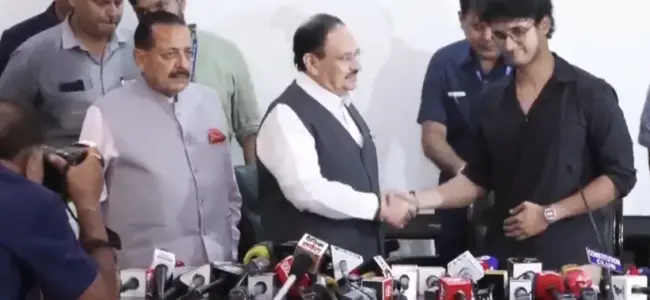
Next round of talks after 4 weeks
Education Minister Dharmendra Pradhan resigns
New Delhi: Soon after Education Minister Dharmendra Pradhan’s resignation, the Cockroach Janta Party (CJP) on Saturday called off its 36-day protest at Jantar Mantar over the NEET issue with immediate effect, saying the government has accepted all its demands.
The two sides will again meet after four weeks to work on broader reforms in the examination system, the CJP said.
Announcing the withdrawal of the protests with immediate effect from all sites across India, CJP spokesperson Saurav Das said besides Pradhan’s resignation, the government has also agreed to provide “honourable” compensation to the families of those who committed suicide and withdrawal of FIRs in Delhi and other BJP-ruled states.
“The CJP declares that we withdraw the agitation in good faith and understanding that the agreed-upon terms will be executed within the agreed-upon timeline,” Das said at a joint press conference along with government interlocutors, Union ministers JP Nadda and Jitendra Singh.
Das was accompanied in the meeting by another CJP spokesperson, Ashotosh Ranka.
“As the government accepted all our demands after 36 days of protests, we appeal to everyone to peacefully withdraw from protest sites and go home,” Ranka said.
Das said they have shared a draft of the demands with the government and the government will share a written guarantee by Tuesday.
Nadda said the CJP representatives came to the meeting with a written draft in which they presented certain points regarding the cases filed during the agitation.
He said along with that, the CJP also raised the remaining demands: that no retaliatory measures should be taken, that compensation should be provided, and that their five-point charter should be considered.
“We discussed these issues in detail. After the discussion, the first point was that no action should be taken and no FIRs should be filed. If any FIRs have already been registered, whether by the Delhi Police or in BJP-ruled states, it will be withdrawn,” Nadda said.
The Union Health Minister said that the government has agreed to give honourable compensation within the rules to the families of NEET suicide victims.
Ranka said the CJP and the government interlocutors will again meet after four weeks and review the agreement and discuss about the issue of reforms in the education sector and decide its future strategy.
He said the CJP’s demands were not radical but purely basic, which the government has now accepted.
Das said altogether three rounds of discussions took place on the key demands – resignation of Dharmendra Pradhan, withdrawal of cases and that in future no cases should be filed against protesters and organisers.
He said the CJP had also demanded Rs one crore compensation for the families of those who lost their lives after the cancellation of the NEET examination on May 3.
“All our demands have been accepted by the government,” Das said.
Ranka said the CJP has given a five-point demand charter which talks about examination reforms. “We will meet again in four weeks with that demand charter so that we can work on broader reform,” he said.
Nadda said the government will provide to CJP copies of FIRs registered.
Facing spiralling protests for his ouster over the NEET issue, Pradhan resigned on Saturday, saying it is not a matter of “individual prestige” for him and he wanted to prevent anti-national forces from exploiting the situation at Jantar Mantar and across the country.
The CJP has led a sit-in at Jantar Mantar since June 20, demanding accountability over the NEET-UG 2026 paper leak and irregularities in the CBSE’s on-screen marking process, besides seeking wider reforms in the conduct of public examinations.
The agitation has galvanised thousands of students in protests across the country and has been supported by major opposition parties.
The protests gained momentum after police on July 18 forcibly shifted activist Sonam Wangchuk, who was on a hunger strike at Jantar Mantar since June 28, to Safdarjung Hospital.
The discontent spilt over into a massive march to Parliament on July 20, which witnessed a strong police response involving lathicharge and the use of tear gas. That day, Nadda held the first formal meeting with the CJP leadership at his residence, signalling the beginning of political engagement.
Earlier, Union Education Minister Dharmendra Pradhan resigned amid mounting pressure over the NEET paper leak controversy, with the Centre conceding the principal demand of the Cockroach Janata Party (CJP)-led agitation after weeks of protests that spread from the national capital to several parts of the country.
Pradhan announced his decision in a statement, saying the developments of the past 10 days had “saddened” him deeply and that the issue was “not a matter of personal prestige”.
Noting that he did not want “anti-national forces” to exploit the situation, Pradhan said he wanted to ensure that “the unity of the nation remains intact”, “the future of even a single student should not become entangled in legal complications” and that students devote their time to studies and building their careers.
“Keeping all these considerations in mind, I have sent my resignation to the Hon’ble Prime Minister,” he said.
Pradhan is the second union minister in Prime Minister Narendra Modi’s tenure to resign following a public controversy. The first was M J Akbar, who stepped down as minister of state for external affairs in 2018 after sexual harassment allegations surfaced against him during the #MeToo movement.
Pradhan’s resignation came a day after the Centre announced measures to address concerns over examination irregularities. These measures included a proposed law prescribing stringent punishment for paper leak involvement and establishing fast-track courts for speedy trials.
The protests were spearheaded by the CJP, a platform launched by former AAP functionary Abhijeet Dipke as a satirical online campaign in May before it turned into one of the most significant youth-led movements in recent times.
Hailing the resignation as a victory for democracy, Dipke announced at the Jantar Mantar protest site that the agitation would continue until its remaining demands were met. “This is democracy. He has resigned. We have two more demands. We won’t go like this,” he said.
Dipke demanded compensation of Rs 1 crore each for the families of students who allegedly died by suicide following the paper leak and action against police personnel involved in the July 20 crackdown on protesters during a march to Parliament that became a major turning point in the agitation, swelling the crowds at the protest site.
The CJP launched its indefinite protest at Jantar Mantar on June 20.
