
Lieutenant Governor Addressed “Shakti Mimamsa” national symposium
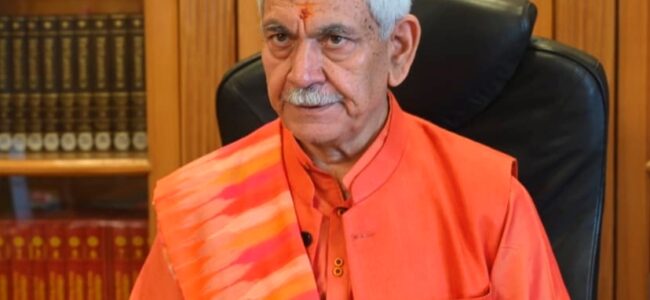
SRINAGAR, JULY 21: The Lieutenant Governor, Manoj Sinha today addressed the “Shakti Mimamsa” national symposium, a collaborative initiative by the Central Sanskrit University (Jammu Campus), Shri Mata Vaishno Devi Shrine Board, and Shri Mata Vaishno Devi University. He said the deliberation on the spiritual heritage of the 51 Shakti Peethas over next 4-days will allow us to reconnect with the ancient Sanatana consciousness that has long defined India’s soul.
“Shakti is the very heartbeat and sustaining consciousness of the cosmos. It manifests in all motion and creation, shining through compassion, knowledge, love, patience, and life itself. From Vedic hymns and Upanishadic philosophy to the Devi Mahatmya, every facet of India’s spiritual heritage highlights that the Supreme Reality and Shakti are eternally inseparable,” the Lieutenant Governor said.
He said the Indian philosophy and spirituality are not just found in ancient texts but they live in our everyday traditions.
“One can see this in village prayers, household Navaratri rituals, and our natural respect for motherly power. In our villages, countless women who have never read a word of Sanskrit embody the true spirit of Shakti through their daily lives. This is the heartbeat of India’s cultural and spiritual continuity. The Shakti Peethas are powerful symbols of our national unity and beacons of our shared cultural consciousness. A nation’s unity is built from shared memories, shared faiths and shared cultural journeys. The Shakti Peethas have carried out this work for centuries. They have united India not merely geographically but emotionally and spiritually as well,” he said.
The Lieutenant Governor said that an academic focus on the Shakti Peethas is more urgent today than ever, driven by several key goals. He said, we must revive our ancient knowledge system and our youth need to realize that these sacred sites are living libraries of Indian philosophy, architecture, art, music, science, and history.
“Our ancestors chose these locations not just for spiritual reasons, but for their natural and cultural importance. Studying these sacred places is rigorous research that helps us understand India’s ancient knowledge traditions on their own terms. The second dimension is the renaissance of feminine consciousness.
