
20 Cloudbursts in 40 Days: Is Jammu & Kashmir Entering an Era of Extreme Weather?
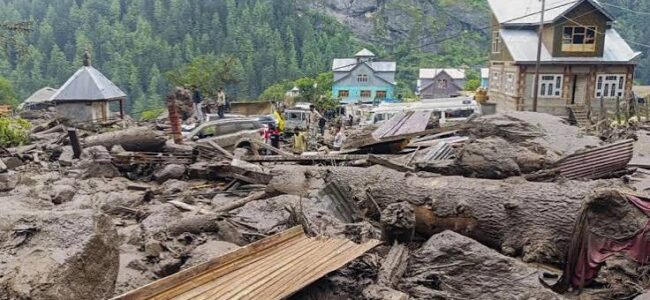
Fourteen incidents reported from Jammu region as Chenab Valley emerges as the UT’s most vulnerable disaster hotspot
Experts link rising cloudbursts to climate change, fragile geology and increasing human pressure on mountain ecosystems
Srinagar: Jammu and Kashmir’s mountains are witnessing a worrying surge in extreme weather events, with nearly 20 cloudburst incidents reported across the Union Territory since June 1 this year, including 14 from the Jammu region alone, raising fresh concerns over the impact of climate change on the fragile Himalayan landscape.
From the steep valleys of Doda and Kishtwar to the upper reaches of Ramban and Poonch, sudden torrents of water, mud and boulders have become an increasingly common sight this monsoon season.
The Chenab Valley comprising Doda, Kishtwar and Ramban districts has emerged as the region’s most vulnerable zone, repeatedly bearing the brunt of cloudbursts, flash floods and landslides. Recent disasters in Thathri, Bhaderwah, Prem Nagar, Drabshalla and the Doda-Kishtwar catchment have once again exposed the area’s growing susceptibility to extreme rainfall events.
Meteorologists and climate experts believe the trend is not accidental.
According to Dr Mukhtar Ahmad, Director of the Meteorological Department in Srinagar, Jammu and Kashmir is increasingly witnessing short-duration, high-intensity rainfall events, replacing the traditional pattern of moderate rainfall spread over several days.
He says warmer atmospheric conditions enable clouds to hold more moisture and release it within a very short time, increasing the likelihood of cloudbursts and flash floods, particularly in mountainous catchments. The interaction of monsoon currents with local topography further intensifies these weather systems over the higher reaches of the Himalayas.
Sonam Lotus, Director of the Meteorological Centre in Ladakh, points out that the Himalayas act as a natural barrier forcing moisture-laden winds to rise rapidly, cool and condense over narrow valleys and mountain slopes.
According to him, this orographic effect, coupled with rising temperatures and changing circulation patterns, is making high-altitude regions increasingly vulnerable to sudden and localised weather extremes.
Independent weather forecaster Faizan Arif believes the frequency of cloudbursts in the Chenab Valley is no longer an exception but an emerging climatic pattern.
He notes that the valley’s steep terrain, fragile geology and deep river gorges create ideal conditions for rapid runoff and debris flows once intense rainfall occurs. Human interventions such as road widening, slope cutting, tunnelling and unplanned construction have further reduced the mountains’ natural resilience.
The arrival of the southwest monsoon in Jammu and Kashmir this year has already triggered multiple incidents of flash floods and cloudbursts across both divisions, with authorities repeatedly issuing advisories for vulnerable areas.
Climate researchers warn that unless ecological safeguards, scientific land-use planning and stronger early warning systems are put in place, such disasters could become more frequent and more destructive in the years ahead.
For the people of the Chenab Valley, however, the warning signs are already visible.
What was once considered a rare weather event is fast becoming an annual summer ordeal.
