
Purple revolution gains momentum as lavender harvest peaks at CSIR-IIIM Bonura farm in Pulwama
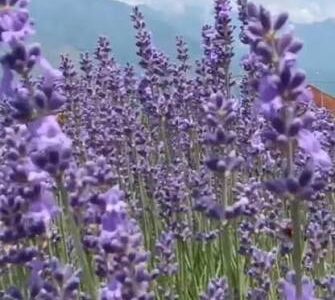
Expansion of aromatic crop cultivation expected to enhance farmers’ income, generate rural employment and strengthen Kashmir’s agri-economy
Pulwama: The much-celebrated Purple Revolution has gathered fresh momentum in Kashmir as the lavender harvesting season reached its peak at the Bonura Drug Farm in Pulwama, operated by CSIR-Indian Institute of Integrative Medicine.
The commencement of harvesting marks another significant step in promoting aromatic and medicinal crop cultivation across the region, with scientists and officials expressing confidence that lavender farming will continue to emerge as a profitable alternative for local farmers.
The sprawling Bonura farm has once again turned into a sea of vibrant purple flowers, attracting researchers, farmers and agriculture enthusiasts eager to witness the harvest and learn about the commercial potential of lavender cultivation. The harvested flowers will be processed for the extraction of high-value lavender essential oil, which is widely used in the pharmaceutical, cosmetic, perfumery and wellness industries.
The initiative forms part of the Centre’s larger vision of diversifying agriculture in Jammu and Kashmir by encouraging farmers to shift towards high-value crops capable of generating substantially higher returns than many conventional farming practices.
Officials said the Purple Revolution has already demonstrated encouraging results in several districts of Jammu and Kashmir, where farmers have adopted lavender cultivation on a commercial scale. Besides improving farm incomes, the initiative has also created opportunities for entrepreneurship, value addition and employment in rural areas through the establishment of distillation units and marketing networks.
At Bonura, scientists are conducting extensive research on improving lavender varieties, enhancing essential oil yield and promoting scientific cultivation practices suited to Kashmir’s climatic conditions. Demonstration plots and farmer training programmes are also being organised regularly to encourage wider adoption of aromatic crops.
Experts believe lavender can be successfully cultivated even on marginal lands where traditional crops often produce limited returns. They also recommend intercropping lavender with suitable agricultural and horticultural crops, allowing farmers to optimise land use while diversifying their sources of income.
The cultivation of medicinal and aromatic plants is increasingly being viewed as a sustainable agricultural model capable of reducing production risks while offering better economic returns. With growing domestic and international demand for natural essential oils, the sector is expected to witness further expansion in the coming years.
The Purple Revolution, supported under various Central Government initiatives, aims to create a complete value chain—from scientific cultivation and quality planting material to processing, branding and market linkage—thereby enabling farmers to realise the full commercial potential of lavender farming.
An official associated with the programme said the response from farmers has been highly encouraging.
“Lavender cultivation has emerged as a promising income-generating opportunity for farmers in Jammu and Kashmir. Through continuous research, quality planting material, field demonstrations and technical support, we are helping farmers adopt scientific cultivation practices. The Purple Revolution is not only improving livelihoods but is also creating new avenues for entrepreneurship and rural employment across the region,” the official said.
Officials added that awareness programmes, hands-on training sessions and technical guidance will continue throughout the season to motivate more farmers to adopt lavender cultivation. They expressed optimism that with sustained institutional support, Kashmir has the potential to become one of the country’s leading hubs for high-quality aromatic and medicinal plants, further strengthening the region’s agricultural economy.
