
History is Created : From 6-Month Shutdown to All-Weather Road: Zojila Tunnel Breakthrough Proves Game Changer
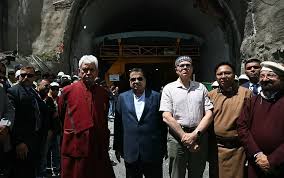
Minimarg (Ladakh): The Zojila tunnel connecting the Kashmir Valley to Ladakh took a crucial step towards completion on Tuesday with a blast breaking through the last 2.5 metres of the high-altitude infrastructure project that cuts through the Himalayas.
With this, the two ends of the world’s longest single-tube bi-directional bypass, which will cut travel time from 1.5 hours to 15 minutes, have now been connected, officials said.
“Breakthrough in the 2.5 metre distance in the tunnel has been successfully achieved,” an official said.
The breakthrough has brought the decades-old dream of all-weather connectivity between the Kashmir Valley and Ladakh closer to reality.
Union Minister for Road Transport and Highways Nitin Gadkari pressed the remote button, blasting the breakthrough site near the East Portal of the tunnel at Minimarg in Ladakh Union Territory, they said.
Jammu and Kashmir Lieutenant Governor Manoj Sinha and Chief Minister Omar Abdullah were also present.
Officials of the National Highways & Infrastructure Development Corporation Limited (NHIDCL) said the breakthrough is six months ahead of schedule.
As of now, about 85 per cent of the total work has been completed, Authority Engineer for the project, Yousef Es’haghpour Rahimabadi, told PTI here.
The tunnel is likely to be thrown open to the public in February 2028, the officials said, adding that after the breakthrough, the civil works will take another 7-8 months and then the electrical works will begin.
The tunnel — 9.5 metre wide, 7.57 metre high, 13.153 km long — is a horseshoe-shaped single-tube, a two-lane road tunnel built at the height of around 11,578 feet above sea level.
The geostrategically important tunnel on the Srinagar-Leh National Highway will provide year-round, all-weather connectivity to Ladakh, reducing the travel time from 1-1.5 hours to 15 minutes, officials said.
The tunnel from Baltal in the Ganderbal district of central Kashmir to Minimarg in Drass district of the Union Territory of Ladakh has an 18-km approach road.
Megha Engineering and Infrastructure Limited (MEIL), the agency executing the project, used the New Austrian Tunnelling Method (NATM) to pierce through the Himalayas and navigate the fragile geology. The entire project is 31 km long, including the approach road and bridges, stretching from Sonmarg to Minimarg.
Once operational, the tunnel would enhance both civilian and military mobility across the treacherous Zojila Pass that is usually rendered shut for traffic for three winter months due to heavy snowfall.
Zojila Tunnel: A Landmark Engineering Achievement
Being constructed between Baltal and Minamarg on National Highway-1, the nearly 14-km-long bi-directional Zojila Tunnel is one of India’s most ambitious mountain infrastructure projects, being developed at a cost of approximately ₹6,800 crore. Built at altitudes ranging from 2,900 metres to 3,310 metres, the project represents a significant engineering accomplishment in one of the world’s most challenging terrains.
Despite heavy snowfall, harsh weather conditions and complex geological challenges, the project has progressed steadily through the efforts of engineers, workers, consultants, contractors, the National Highways & Infrastructure Development Corporation Limited (NHIDCL) and other stakeholders.
Advanced Safety Features and World-Class Infrastructure
The tunnel will be equipped with modern ventilation systems, automatic fire detection systems, advanced CCTV surveillance and cross-passage facilities for pedestrians to ensure safe and efficient travel.
To address snow loads and geological challenges, the project includes eight cut-and-cover sections, four bridges, 40 culverts, snow galleries, catch dams, avalanche protection structures, approach roads and state-of-the-art safety arrangements.
Transforming Connectivity, Tourism and Strategic Mobility
The Zojila Tunnel is much more than a transportation project and will serve as a gateway to development for the region.
Upon completion, travel time between Sonamarg and Minamarg will be reduced from nearly two hours to about 30 minutes, resulting in significant savings in time and fuel. The project will also reduce accident risks and disruptions caused by avalanches and adverse weather conditions.
The tunnel is expected to boost tourism, facilitate trade, improve access to remote areas and strengthen connectivity to border regions. From a national security perspective, year-round connectivity will enable faster and more efficient movement of the Indian Army, equipment, supplies and logistics, thereby strengthening strategic preparedness.
The project will also generate employment opportunities, promote economic growth and improve the quality of life of local communities through enhanced connectivity and regional integration. (with inputs from PTI)
