
Rapid transformation in Ladakh since 2019, UT remains PM Modi’s focus: Shah
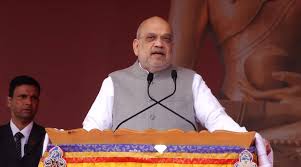
Announces plans for dairy sector expansion in Ladakh
Leh/Jammu: Union Home Minister Amit Shah on Friday said Ladakh was a model of rapid transformation since the 2019 bifurcation of the erstwhile state of Jammu and Kashmir, and listed sweeping political, social and economic changes in the Union territory.
The region has remained at the centre of Prime Minister Narendra Modi-led government’s development agenda, he said.
Shah said Ladakh had long demanded Union territory status due to lack of development and asserted that the decision had brought visible change across sectors.
His remarks came amid renewed calls by the Leh Apex Body and the Kargil Democratic Alliance (KDA) for resumption of talks with the Centre on statehood and inclusion under the Sixth Schedule.
“Ladakh had an old demand to be made a Union territory. The basic reason for this demand was that development was not taking place here. Now I want to tell you what has been done after it was made a Union Territory in 2019,” Shah said.
He said that Ladakh has now seven districts and 193 panchayats, with five new districts — Sham, Nubra, Changthang, Zanskar and Drass — created and notifications already issued.
Shah said that local languages had also been given administrative recognition. “Earlier only Hindi and English were in use, but now Bhoti, Purgi and Urdu have also been accorded importance”.
Highlighting infrastructure growth, he said road length in Ladakh has increased from about 1,799 km before 2019 to 4,040 km now. “The road constructions has almost doubled.”
The Centre bifurcated the erstwhile state of J-K into two Union territories – Jammu and Kashmir and Ladakh – on August 5, 2019, when it also abrogated Article 370 of the Constitution that gave special status to the erstwhile state.
Shah said that the number of bridges has risen from 19 to 72 increasing the number by three times.
Spelling out development in other sectors, he said that mobile towers have increased from 344 to 653, while helipads have gone up from seven to 41, he said. “Snow-clearing machines, crucial for the region, have increased from 60 to 215.”
On power infrastructure, Shah said grid-related works have increased from 145 to 184, while distribution transformers have gone up from 1,182 to 3,153.
“I am giving these figures on this scale because after becoming a Union Territory, it (Ladakh) has remained the focus of the Narendra Modi government, the focus of the prime minister of the country, and so many development works have taken place together,” the minister said.
He said the impact of better infrastructure was visible in road connectivity, with the Zojila Pass, which earlier remained shut for 127 days, remaining closed for only 19 days this year. “The Kargil-Leh road, which earlier remained closed for nearly 175 days, was shut for only 11 days.”
Shah said work on the Zojila tunnel is in progress, construction of the Shinkun La tunnel has started and a new civil airport is also coming up.
He said that VSAT connectivity has been extended to all panchayats and major work has been undertaken to upgrade telecom towers.
In the education sector, Shah said Sindhu Central University has been established, 174 ICT labs set up, 130 smart classrooms created, 40 science laboratories built and 24 Atal Tinkering Labs established.
He said Ladakh became a fully literate administrative unit in 2024 and claimed there was no illiterate person left in the region.
“Nearly 98 per cent households have been provided tap water connections under the Har Ghar Jal scheme, while substantial work has also been carried out in agriculture and horticulture,” he said.
Shah said Ladakh’s budget has risen from Rs 1,000 crore when it was part of the erstwhile Jammu and Kashmir state to Rs 6,000 crore now.
He also announced the formation of the Sindhu Infrastructure Development Corporation, saying it would play an important role in promoting industrial growth in the coming years. “We want this border region to become self-reliant,” Shah said.
He asserted that development in the UT is because of the vision of the prime minister.
Shah also announced plans for a major expansion of the dairy sector in Ladakh and Kargil, including the setting up of a 50,000 litre-per-day milk processing plant in Leh.
The government is committed to strengthening dairy infrastructure in Ladakh and Kargil to ensure sustainable livelihood and enhance the income of dairy farmers, Shah said.
Extending Buddha Purnima greetings to the locals, the minister said that the teachings of Lord Buddha, especially the message ‘Appo Deepo Bhava’ (be your own light), continue to inspire people towards self-reliance and higher purpose.
“We are also working to further strengthen infrastructure in Ladakh as well as in Kargil. In the coming days, a new dairy plant with a processing capacity of around 50,000 litres per day will be set up in Leh at an estimated cost of Rs 70 crore,” he said.
Shah, who laid the foundation of some projects and inaugurated others in the dairy sector in Ladakh, said that cattle breeding centres will also be established in Leh and Kargil at a cost of around Rs 4 crore each to provide high-yielding breeds suited to local climatic conditions.
“Around 500 improved cattle are planned to be introduced annually, with a long-term goal of nearly tripling livestock numbers in the region over the next decade,” he added.
Given the extremely cold climate and low oxygen levels in the region, research will be carried out to ensure that the livestock introduced here are well adapted, he said, adding that with the addition of new animals and their offspring over time, this initiative will expand significantly.
“Over the next ten years, there is a plan to nearly triple the livestock population, which I believe will yield very positive results,” the minister said.
Shah further said that following the integration with the National Dairy Development Board, the Ladakh Milk Federation network has expanded to 28 villages.
However, he stressed the need to extend coverage to at least 85 per cent of villages where livestock rearing is viable to ensure a stable income for farmers.
He said daily milk procurement in the region has reached around 6,000 litres and called for scaling it up to 21,000 litres in the coming years. Expansion of processing capacity and tie-ups with the Indian Army, he added, will provide a stable and assured market for dairy farmers.
“Expansion of plant capacity — from 5 TLPD to 10 TLPD — and agreements with the Army will certainly be beneficial,” he said.
The Union minister urged the Ladakh administration to fully utilise the potential of every suitable village and promote cooperative-based development in allied sectors such as organic farming and honey production.
He also noted that, under the leadership of Prime Minister Narendra Modi, several initiatives have been launched in the animal husbandry sector in Ladakh.
“The foundation stone of a dairy processing plant in Kargil with a capacity of 10,000 litres per day has been laid, aimed at strengthening local dairy infrastructure even in high-altitude areas,” he said.
Congratulating the women of Kargil, Shah said the initiative would help them become self-reliant and improve their livelihoods. He said the new project, being set up at a cost of Rs 25 crore, is expected to significantly benefit local families.
He added that the existing milk union has already begun producing around 500 kg of paneer and 1,000 kg of curd daily, and with modernisation, production will become more efficient.
Highlighting demand, Shah said forces such as the Indian Army and the Indo-Tibetan Border Police (ITBP), with around 18,000 personnel deployed in the region, will serve as major consumers of dairy products.
He also announced the launch of mobile milk testing facilities to improve quality control and a technology-driven digital Automated Milk Collection System (AMCS) to ensure transparency and efficiency in procurement operations.
He praised the role of the local women in the initiative.
