
Clinging to the Cliffs: Kashmir’s Markhor Stages a Quiet Comeback
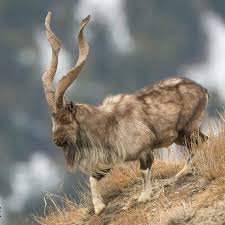
Rising numbers offer hope, but experts warn habitat pressure and human interference still threaten survival
Our Special Correspondent
Srinagar: High in the craggy mountains of Kashmir, where sheer cliffs defy gravity, the markhor—the world’s largest wild goat—moves with a rare elegance.
With its corkscrew horns and remarkable climbing ability, the species has long been a symbol of the Himalayan wilderness. Today, it is also emerging as a fragile conservation success story.
The markhor (Capra falconeri), found across parts of South and Central Asia, is currently listed as “Near Threatened” on the IUCN Red List after once being categorised as endangered due to extensive hunting and habitat loss. In India, the Kashmir subspecies (Capra falconeri cashmiriensis) survives in limited pockets, mainly in the Pir Panjal and Kazinag ranges.
In Jammu and Kashmir, wildlife officials estimate that only a few hundred individuals remain, though the population has shown gradual recovery from critically low levels in the early 2000s. Two main populations persist—one in Hirpora Wildlife Sanctuary and another in Kazinag National Park—highlighting both the species’ resilience and its vulnerability.
“From less than a couple of hundred animals two decades ago, we are now seeing encouraging numbers,” said a senior official from the Department of Wildlife Protection. “But this is still a very small population in ecological terms.”
Globally, conservation efforts have demonstrated that recovery is possible. A 2024 field study in Pakistan’s Chitral Gol National Park recorded over 2,200 markhor individuals, reflecting a strong rebound in protected habitats. Experts say such examples offer lessons for Kashmir as well.
“Where community participation and strict protection go hand in hand, markhor populations have stabilised and even increased,” noted a wildlife researcher involved in mountain biodiversity studies. “Kashmir can replicate similar models, but sustained effort is crucial.”
Despite the gains, threats continue to loom large. Habitat degradation, competition with livestock, and human disturbance are among the most pressing concerns. Expanding grazing pressure in alpine pastures is limiting the markhor’s feeding grounds and movement patterns in Kashmir’s fragile ecosystems.
“Livestock grazing is now one of the biggest challenges,” said an environmental scientist. “It’s not just about space—it’s about the quality of habitat. The markhor depends on specific vegetation and terrain, which are increasingly under stress.”
Climate change is compounding the problem. Shrinking snowlines and altered vegetation cycles are affecting the high-altitude ecosystems the species depends on. Conservationists warn that even minor disruptions can have disproportionate impacts on such a small and localised population.
On the ground, however, attitudes are slowly changing. In several border villages of North Kashmir, local communities have begun to take pride in protecting the species. Awareness campaigns and stricter enforcement have reduced instances of poaching, once a major threat.
“We used to hear stories of people hunting markhor in the past, but now things have changed,” said Bashir Ahmad, a resident of Kupwara. “These animals are part of our mountains and our identity. If we lose them, we lose a part of ourselves. People here are more aware now and want to protect them.”
The government has also stepped up efforts, with periodic population censuses and increased surveillance. A fresh census initiative aims to generate updated data to guide future conservation strategies.
Experts believe that while the markhor’s comeback is encouraging, it remains incomplete. “This is not a success story yet—it’s a recovery in progress,” said a conservation biologist. “If protection weakens even slightly, the species could slip back.”
As the sun sets over the Pir Panjal, the silhouette of a markhor perched on a rocky ledge stands as a powerful reminder—not just of survival, but of the delicate balance between nature and human intervention.
