
Silent Siege: Porcupines Put Kashmir’s Saffron at Risk
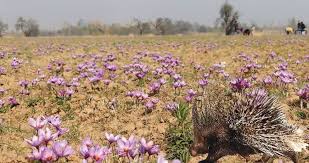
Relentless burrowers threaten a centuries-old crop, leaving farmers to battle an unseen force
Our Special Correspondent
Srinagar: In the saffron fields of Pampore, where autumn once painted the land in soft shades of purple, a quiet unease now lingers. By day, the fields appear calm, stretching gently across the plateau, carrying the weight of generations who have nurtured this rare and delicate crop. But when darkness settles, the stillness begins to shift.
The soil, which holds the promise of saffron, also hides its greatest danger.
Under the cover of night, the Indian crested porcupine emerges from the edges of nearby scrublands and broken forest patches. Slow and careful in its movement, it searches not for leaves or fruit, but for what lies beneath. With sharp claws and strong teeth, it begins to dig. The earth gives way easily, and within moments, the saffron corms—small, unseen, yet vital—are pulled out and consumed.
By morning, the damage is done. The fields are left with small pits, as if the land itself has been quietly undone. For farmers, it is not just the loss of a day’s work. Each corm destroyed is a season erased, a future harvest lost before it could even begin.
“We go to sleep with hope and wake up to loss,” says Ghulam Nabi, a saffron grower from Pampore. “In one night, they can destroy a part of the field that took us months to prepare. It feels like the land is slipping away from us.”
Saffron, drawn from the flower Crocus sativus, is among the most demanding crops in the world. It asks for patience, precise conditions, and unwavering care. In Kashmir, it has long been more than a source of income. It is a symbol of continuity, of families bound to the same land across generations. Its threads carry the story of a place as much as they do their rich color and fragrance.
Yet today, that story feels increasingly fragile.
In recent years, porcupine attacks have grown more frequent, turning what was once an occasional nuisance into a persistent threat. Farmers speak of nights when entire patches are ruined, when weeks of effort disappear without a trace. The struggle is made harder by the fact that the animal cannot be harmed. Protected by law, it moves freely, adapting quickly to every attempt to keep it away.
“We cannot guard the fields all night, every night,” says Abdul Rashid, another farmer. “Even if we try, the porcupines come silently. By the time we notice, the damage is already done.”
The reasons for its growing presence lie beyond the fields. Forest areas have shrunk, food sources in the wild have become uncertain, and changing weather patterns have altered the balance that once kept wildlife and farmland apart. Pushed out of their natural habitat, these animals have found their way into cultivated land, where food is easier to reach and often more nourishing.
“This is a classic case of habitat disturbance,” explains Dr. Shabir Ahmad, an agricultural expert. “As natural ecosystems shrink, species like porcupines adapt by moving into farmlands. Saffron corms are rich in nutrients, which makes them an easy and attractive food source.”
And so, an unlikely conflict unfolds—not out of choice, but out of necessity on both sides.
Farmers try what they can. They place barriers, light up the edges of their land, and experiment with natural repellents. For a while, it works. Then the animals return, digging deeper, moving quietly, always a step ahead. The battle feels uneven, almost invisible, yet deeply felt.
“Traditional methods are no longer enough,” says an official from the agriculture department. “We need coordinated efforts—scientific solutions, better fencing techniques, and support for farmers to protect their fields without harming wildlife.”
What makes it harder is the silence of it all. There are no loud signs of destruction, no immediate warning. Only the slow realization at dawn that something valuable has been taken away. It is a kind of loss that builds over time, quietly wearing down both land and spirit.
And still, the fields are tended.
Each season, farmers return to the soil, replanting, hoping, trusting that the land will respond as it always has. Because despite the uncertainty, saffron remains tied to who they are. Letting it go is not an option they are ready to accept.
“We have inherited this land from our forefathers,” Ghulam Nabi says, looking over his scarred field. “No matter how difficult it becomes, we will continue. This is not just farming for us—it is our identity.”
As evening falls once more over Pampore, the fields grow still again. The wind moves gently across the land, carrying with it the faint memory of past harvests. Beneath the surface, however, the ground holds its tension.
For in that darkness, the struggle continues—unseen, unheard, yet shaping the future of Kashmir’s most treasured crop.
