
Kashmir’s ‘Paddy Bowl’ Shrinks as Fields Disappear Under Concrete, Orchards
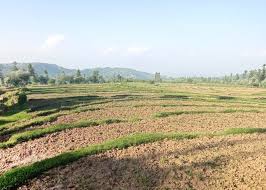
Declining paddy acreage in Budgam, Pulwama and Kulgam raises food security concerns as experts warn of rising dependence on imported rice
Our Special Correspondent
Srinagar: Kashmir’s vast stretches of paddy fields—once the defining feature of the Valley’s rural landscape—are steadily shrinking, raising alarm among farmers, experts and policymakers about the future of rice cultivation and the region’s long-term food security. For decades, districts such as Budgam district, Pulwama district and Kulgam district formed the backbone of the Valley’s rice production and were widely known as Kashmir’s “paddy bowl.”
Today, however, large swathes of fertile land in these districts are gradually being converted into residential colonies, commercial establishments and orchards, dramatically altering the traditional agrarian landscape.
Official data indicates that the area under paddy cultivation in the Valley has declined noticeably in recent years. According to figures from the Agriculture Production Department Jammu and Kashmir, paddy acreage has dropped from about 1.41 lakh hectares in 2020 to nearly 1.30 lakh hectares in 2025, reflecting a reduction of more than 11,000 hectares in just five years.
Agriculture experts attribute the decline to a combination of factors including rapid urbanisation, fragmentation of landholdings, labour shortages and the growing shift towards horticulture crops that offer higher returns.
“In many areas, farmers are converting paddy fields into orchards or selling land for construction,” an agriculture department official said. “While horticulture is economically beneficial, the decline in paddy cultivation could have serious implications for food security if not addressed.”
Historically, rice has been the staple food of Kashmir, and local production once met a significant portion of the Valley’s demand. However, officials say the region now faces a widening gap between production and consumption.
Estimates suggest the region produces around 4.5 lakh tonnes of food grains annually, while the requirement is close to 13 lakh tonnes, leaving a substantial deficit that is met through supplies from other states.
Farmers say the transformation of the countryside has been gradual but unmistakable. “Earlier, entire villages were surrounded by paddy fields,” said a farmer from Pulwama. “Now many of those fields have turned into apple orchards or houses. Farming paddy has become less profitable.”
The shift toward apple cultivation—one of the Valley’s most lucrative agricultural activities—has particularly accelerated in districts such as Kulgam and Pulwama, where many farmers have replaced traditional rice fields with high-density apple orchards.
Environmentalists warn that the loss of paddy fields is not only an agricultural concern but also an ecological one. Besides producing food, paddy lands play a vital role in groundwater recharge, flood absorption and maintaining ecological balance in the Valley.
With urban expansion continuing around Srinagar and other growing towns, experts stress the need for stricter protection of agricultural land and policies that make paddy farming economically viable.
“The shrinking paddy belt is a warning sign,” an agricultural economist said. “If the current trend continues unchecked, Kashmir may become almost entirely dependent on rice imports from other states.”
For now, the gradual disappearance of Kashmir’s once-expansive paddy bowl reflects a changing rural reality—one where the lush green fields that sustained generations are slowly giving way to orchards, concrete structures and expanding settlements.
