
Defying nature : SKUAST Students Make Tulips Flower All Year Round Feature
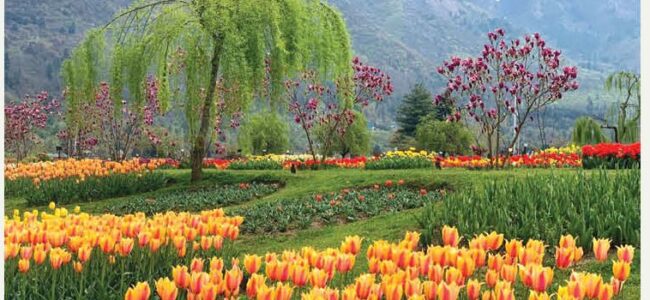
Young agri-scientists in Kashmir recreate spring inside labs, opening doors for round-the-clock tulip cultivation & new hope for local floriculture
Our Special Correspondent
Srinagar: In a breakthrough that could redefine Kashmir’s iconic tulip industry, students of Sher-e-Kashmir University of Agricultural Sciences and Technology (SKUAST-K) have successfully grown tulips beyond their natural blooming season, managing to produce flowers “round the clock” inside controlled conditions.
The achievement, accomplished inside the university’s protected cultivation and floriculture facilities at Shalimar campus, marks a significant step toward year-round tulip production — something once considered nearly impossible in Kashmir where tulips traditionally bloom only for a few weeks in spring.
For generations, tulips have symbolised Kashmir’s brief but spectacular spring. Every April, the Indira Gandhi Memorial Tulip Garden opens and millions of visitors arrive to witness the short-lived bloom. But the flowers disappear just as quickly as they arrive. Now, SKUAST students may have changed that story.
Using controlled temperature chambers, artificial photoperiod (light duration) regulation, and bulb conditioning techniques, the students simulated seasonal cycles inside a laboratory environment. The bulbs were “fooled” into believing that winter had passed and spring had arrived — even in the middle of winter.
“We recreated nature indoors,” said one of the student researchers, Aaliya Rashid, part of the floriculture research group. “Tulips normally need a chilling period followed by gradual warming. We carefully manipulated temperature and light so the plant experienced all four seasons within weeks.”
Another student, Irfan Ahmad, explained that the team worked for months experimenting with bulb storage, humidity and light exposure.
“At first most bulbs failed to sprout or produced weak stems,” he said. “But after multiple trials, we found the correct chilling hours and light intensity. The day we saw the first healthy bud forming in January, we literally celebrated inside the lab.”
Faculty members guiding the project said the experiment demonstrates the potential of controlled floriculture in Kashmir, especially for export markets and off-season tourism displays.
“We are not just growing flowers; we are developing a technology,” said a supervising researcher from the Division of Floriculture and Landscape Architecture. “If scaled, Kashmir can supply tulips to markets even when Europe and other regions are off-season.”
Students said the effort was also driven by emotion. Many of them grew up visiting the Tulip Garden as children.
“I always felt sad that the tulip season ends so quickly,” said student researcher Mehak Nabi. “We wanted tourists to see Kashmir’s tulips even in winter. Now it feels possible.”
The innovation could have strong economic implications. Floriculture experts believe off-season tulip production can help local growers, nursery owners and landscapers by creating a new commercial cycle rather than a once-a-year income opportunity.
Beyond business, the achievement also highlights the rising role of youth in agricultural innovation in Jammu and Kashmir. Instead of traditional farming alone, students are increasingly focusing on protected cultivation, high-value crops and horticultural technology.
University officials praised the students’ work, calling it a “research-to-society” model.
“What makes this special is that it was driven by students themselves,” a faculty member said. “They were curious, persistent and refused to accept that tulips must bloom only once a year.”
Back in the lab, the rows of brightly coloured flowers — red, yellow and purple — now bloom under artificial lights while winter still grips the Valley outside.
Standing beside the flowers, Irfan smiled and said softly,
“Spring doesn’t have to wait for April anymore. We’ve brought a piece of it into every season.”
