
Reservation policy : Cabinet sub-committee report accepted: CM
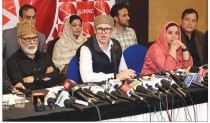
Srinagar: Chief Minister Omar Abdullah on Saturday said the Cabinet sub-committee report on the reservation policy in the Union Territory has been accepted by the Cabinet and will be forwarded to the lieutenant governor for approval.
“There is no point in getting into speculations. The only people who know what has been proposed in this are the members of the Cabinet. And therefore, to speculate about what is being slashed, what is being cut, would not be correct at this point in time. The Cabinet sub-committee’s report has been accepted by the Cabinet. The department has been asked to prepare a memo for the Cabinet’s approval. This will then go to the LG (for approval) as all Cabinet decisions go,” Abdullah told reporters here.
The chief minister was responding to questions about opposition accusing his government of slashing the quota of RBA (resident of backward area) category in the reservation policy.
He said it would be inappropriate for him to comment on the contents of the report before it reaches the Raj Bhawan.
“For me now, before the memo has reached the LG, to start discussing the contents of that memo would be incorrect,” he said.
He said the reservation report will be announced only after the lieutenant governor approves it.
Asked about some sections demanding that the report be made public, the chief minister said it does not work that way.
“No government works under pressure, and I am the last person who you can pressurise to do something. There is a procedure, and that is being followed. It is not only impropriety, it is bordering on illegal to release the information that has not even reached the LG,” he added.
The CM said his government’s efforts to bring back tourists to the Union territory can work only after the tourist spots closed in the wake of Pahalgam terror attack are reopened.
“First, we have to reopen those places which have been shut. We did not shut these places in 35 years. When the militancy was at its peak, Drang or Doodhpathri were not closed, the upper areas of Gulmarg were not shut, Aru valley was not closed,” he told reporters here.
Abdullah said some courage is needed to be shown and open tourist spots and promote them effectively.
Addressing criticism that his government was focusing too much on tourism, the chief minister said, “We are trying at our own level despite the fact that we are subjected to taunts that why are we doing so much tourism promotion?
“We know that homes of lakhs of people depend on it and we want tourism to be restored to the level that was there before the Pahalgam attack.”
The chief minister said his government has sent teams outside the country to promote tourism, pointing out that a big delegation is in Singapore to restore tourism from Southeast Asia. They will also go to Berlin and London next month for tourism promotion, he added.
“If we talk about within the country, Nasir (Aslam Wani) had recently gone to Udaipur for promotions. We are not leaving any stone unturned. I cannot say that the Centre has not supported us, but, the reality is that unfortunately, we are talking in two voices from within J-K.
“On one hand, the elected government talks about tourism promotion, but on the other, the unelected government has kept a large part of Kashmir closed for tourism,” he said.
Abdullah said if they is afraid to reopen famous resorts like Doodhpathri, Drang and some parts of Gulmarg, “it means there is danger. That is the reason the tourists are not coming.”
The CM also asserted he will not ally with the BJP to hasten the restoration of statehood to the Union Territory, saying his party has no intention of repeating the “mistakes” committed by others in the past.
The chief minister also said he is exploring the possibility of becoming a party to the plea for the restoration of statehood to J-K in the Supreme Court.
The Supreme Court is hearing a batch of pleas seeking restoration of statehood to the Union Territory of Jammu and Kashmir, and on October 10, it gave the Centre four weeks to file its response.
Abdullah said if the restoration of statehood is dependent on the BJP coming to power in JK, then the national party should be honest in saying so.
“If that is the deal that is to be struck with the people, then the BJP should be honest, because the BJP in its manifesto and its promises to Parliament and to the Supreme Court never said that the statehood is dependent on the BJP coming to power in JK.
“If that is the case, then I think the BJP should be honest, they should tell us that so long as there is a non-BJP government in J-K, you will not get statehood. Then we will decide what we want to do,” he said.
However, Abdullah added that “tying up with the BJP or an alliance with the BJP is out of the question”.
He said J-K is “still suffering the after-effects” of the PDP-BJP alliance in 2015.
“We have already seen how much that has destroyed J-K. An unnecessary alliance between the PDP and the BJP was born in 2015. We are still suffering the after-effects of that. I have no intention of repeating mistakes that other people have made,” the CM added.
Asked if he had any hopes with the Supreme Court on the restoration of statehood, Abdullah said, “We should have hopes. But it is also right that somewhere Pahalgam is being linked to restoration of statehood. People of J-K did not support it. No one involved in the attack was from J-K.”
Abdullah added, “I won’t go into the politics of it. Repeatedly it was said in Parliament that there are three steps – delimitation, election and statehood. Two steps have been taken, now we hope the third will also be done,” he added.
Abdullah said he is consulting senior lawyers in Jammu and Kashmir as well as in Delhi about the possibility of becoming a party to the statehood restoration petition before the apex court in view of his unique experience as having been a chief minister of the state and also a Union Territory.
“I don’t think anybody else understands the disadvantages that we are put to by being a UT than I do. I am the only person in the entire country with the experience of being both the chief minister of a state and the chief minister of a UT. I can put it on paper and share with the honourable Supreme Court when they have to decide about the statehood to J-K.
“That said, it is for my lawyers to advise whether it would actually be beneficial to the people of J-K. If that is, I have no hesitation in becoming a party to this case in the SC. So, this is something that is actively being discussed with a legal team and based on their opinion, there is a possibility that as chief minister, I will make myself a party to this case,” he added.
Highlighting the “confusion” in the dual system of governance in a UT, Abdullah said he had appointed an advocate general within days of assuming office as the post is the legal face of the government.
“We appointed an advocate general within days of coming to power. We asked the existing AG to continue but he was asked not to attend office. Technically, we have an AG but he has not been allowed to work,” the NC vice president said.
Abdullah said he believes that the authority to appoint the advocate general is with the elected government.
“The absence of AG is not good for us. He is the legal face of the government,” he said.
On the recent crisis in Ladakh, he said it was unfortunate as promises were made to the people there but “not kept”.
“The crisis in Ladakh is extremely unfortunate. Promises were made which have not been kept and it seems to be a practice, particularly in the case of J-K. Ladakhis were promised the Sixth Schedule but not granted. The People of Ladakh were pushed to the wall. Do you want to push the people of Jammu and Kashmir to the wall as well?” he asked.
Abdullah said if promises are made, they should be kept as well.
The NC leader also raised the issue of different domicile yardsticks in Ladakh and Jammu and Kashmir.
“Two Union Territories were born out of one state on 5 August 2019. Yet in some respects, Jammu and Kashmir has been treated very differently to Ladakh and one of those areas is the domicile law. That I believe is something that needs to be brought at par but for us, the more important question is that the main promises made to the people to Jammu and Kashmir and Ladakh should be kept,” he said.
