
Vanishing Greens: J&K’s Forests Shrink as Climate, Concrete Close In
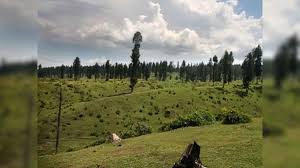
From alpine meadows to foothill woods, rising temperatures, urban expansion and fires are thinning the Valley’s natural shield
Our Special Correspondent
Srinagar: For generations in Kashmir, the mountains were read by their colour. Deep green slopes meant stable seasons, flowing springs and cool summers. Today, that colour is fading.
Across Jammu & Kashmir, scientists and foresters say the region is not only losing glaciers — it is quietly losing its green cover, the living system that regulates climate, snowfall and water. The change is slow enough to miss in a single year, but clear across decades: thinner forests, drier slopes and shrinking pastures.
Official assessments show that Jammu & Kashmir still remains one of India’s forest-rich regions, with roughly around 48–50% of its geographical area recorded as forest and tree cover. But ecologists caution that the figure hides a worrying trend — dense forests are gradually degrading into open forests and scrub.
Forest Survey of India (FSI) assessments indicate that while overall recorded forest area may appear stable, dense forest patches are declining and fragmenting, particularly in the Pir Panjal foothills, Chenab Valley and parts of North Kashmir. In many places, closed canopy forests are being replaced by sparse woodland.
The consequences are already visible on the ground.
Villagers in upper belts of Kupwara, Bandipora and Poonch report springs drying earlier than before. Meadows that once held moisture through summer now turn brown by July.
Forests are not just trees; they act as climate regulators. They trap moisture, control soil temperature and help snowfall remain on slopes longer. Without them, both heat and snowmelt accelerate.
Environmental experts say three forces are driving the decline.
Urban expansion is the most visible. Around Srinagar and other towns, orchards and forest fringes are steadily being converted into housing colonies, roads and tourism infrastructure. Construction along mountain slopes destabilises soil and removes natural vegetation that once absorbed rainwater.
The second pressure comes from forest fires, which have increased sharply in recent years. Warmer winters and reduced snowfall dry the forest floor, making pine forests particularly vulnerable. Officials note that most fires are surface fires, but repeated burning prevents regeneration of young trees and gradually converts forest into scrubland.
Third is climate change itself. Rising temperatures are shifting vegetation zones upward. Tree species adapted to cold conditions struggle to regenerate, while invasive shrubs spread faster. Alpine pastures — locally known as margs — are shrinking as the snowline rises.
Foresters explain that forests and glaciers are directly linked. When forest cover reduces, slopes heat faster, snowfall melts earlier and groundwater recharge declines. That in turn weakens springs and rivers originating from glacial catchments.
Hydrologists note that many traditional water springs in mid-altitude villages have already reduced discharge or become seasonal. The loss of vegetation reduces soil’s ability to hold water, meaning rainfall flows away quickly instead of seeping underground.
Wildlife is also affected. Habitat fragmentation has pwushed animals closer to human settlements, increasing man-animal conflict. Black bears and leopards increasingly descend into villages not merely for food, but because forest corridors are shrinking.
Scientists warn that the region is entering a feedback cycle: fewer forests lead to warmer local temperatures, warmer temperatures reduce snow retention, and reduced snow further dries forests.
The green cover once functioned as Kashmir’s natural air-conditioner. Trees cooled the Valley, slowed winds and preserved moisture. Without that buffer, the impact of heatwaves becomes sharper — one reason experts link recent abnormal winter warmth to ecological changes beyond global warming alone.
The loss is not sudden like a flood or earthquake. It is gradual — a hillside cleared for a road, a fire that returns each summer, a pasture that no longer greens after snow.
From a distance the mountains still look green.
Up close, scientists say, they are growing thinner — and with them, Kashmir’s natural protection against climate extremes is weakening.
