
Environmental Education as a Transformative Vision of NEP 2020
Tawheed Parvaiz
In 2020, the Government of India introduced a concise yet visionary document known as the National Education Policy (NEP) 2020, further strengthened by the National Curriculum Framework (NCF) 2023.
NEP 2020 is not merely a policy reform; it is a transformative framework that has the potential to redefine the entire education system of the country if implemented in its true spirit. It offers educators a clear roadmap to achieve the aims of education through learning outcomes, competency-based education, curricular goals, and holistic developmental domains.
The policy goes far beyond academic achievement. It seeks to nurture responsible, ethical, creative, and socially conscious citizens who are capable of addressing real-world challenges. Among these challenges, environmental degradation stands out as one of the most urgent and existential threats confronting humanity today.
Environmental Crisis is a Global Concern and an Educational Responsibility, In the modern world, humanity is grappling with multiple crises, wars, rapid technological advancement, digitalisation, social unrest, and widening inequalities.
However, the degradation of the environment remains one of the most critical and pressing challenges of our time. Earth, the only known living planet in the universe, can sustain life only if its natural systems remain intact. Environmental destruction threatens human survival, biodiversity, ecological balance, and sustainable development.
Climate change, pollution, deforestation, depletion of water resources, and loss of biodiversity are no longer distant concerns; they are lived realities. Addressing these challenges requires strong policies, innovative strategies, and a collective societal response. Recognising this urgent need, great minds across the nation came together to frame a visionary education policy-NEP 2020, which acknowledges that education is the most powerful tool for environmental protection and sustainability.
A key objective of NEP 2020 is to create awareness, equip learners with essential skills, and nurture environmental responsibility among the younger generation, enabling them to protect and preserve nature.
Environmental Education in Indian Education Policies: A Progressive Shift
India has witnessed several education policies in the past, including NEP 1968, NEP 1986, and its revised version in 1992. While these policies recognised the importance of environmental education, they did not address it with the urgency, depth, and integration seen in NEP 2020. NEP 2020 marks a significant shift by placing environmental education at the heart of the curriculum. It assigns a central role to education in environmental conservation, climate action, and sustainable development.
The policy strongly emphasises, Integration of environmental awareness, water conservation, and resource management across all subjects, Introduction of environmental education as a contemporary and relevant area of learning at different stages of schooling,
Incorporation of traditional Indian knowledge systems and India’s environmental values, Inculcation of respect, responsibility, and ethical behaviour towards nature and mandatory integration of environmental education in all B.Ed. and teacher education programmes.
These provisions clearly demonstrate that NEP 2020 views education not merely as a means of knowledge transmission, but as a moral and social responsibility to safeguard the environment. The policy empowers educators to nurture environmentally responsible citizens from the foundational stage to higher education.
Environmental Ethics: The Foundation of Sustainable Behaviour, the most crucial dimension of environmental education is the development of environmental ethics among children. When ethical values related to nature are instilled at an early age, learners develop a lifelong commitment to protecting the environment.
Knowledge without values cannot bring sustainable change. Therefore, educators must move beyond textbook-based teaching and focus on awareness, attitudes, values, ethical reasoning, and real-life problem-solving. Environmental education should inspire learners not only to understand environmental problems but also to take ownership of solutions.
Experiential Learning and 21st-Century Skills in Environmental Education:
NEP 2020 and NCF 2023 strongly advocate the development of 21st-century skills such as critical thinking, creativity, collaboration, communication, and problem-solving. When these competencies are integrated with environmental education, learners become capable of analysing environmental issues and actively contributing to their resolution.
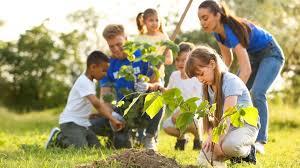
This cannot be achieved through rote learning confined within classroom walls. NEP 2020 identifies experiential learning as the most effective approach for developing competencies. Learning through observation, fieldwork, projects, community engagement, and real-life experiences enables students to connect theory with practice.
A Living Example of NEP 2020 in Action: Experiential Environmental Learning
A remarkable example of experiential learning in environmental education is Nyla Ali, Senior Lecturer in Environmental Science at Boys Higher Secondary School, Zainakote, Srinagar. The school is located on the banks of the renowned Hokersar Wetland, a vital ecological site of immense environmental significance.
Rather than limiting teaching to classroom instruction aimed solely at examination results, she adopted a nature-based, experiential approach. She initiated several environmental projects focused on protecting the Hokersar Wetland from pollution and ecological degradation.
Through Green School initiatives, participation in national movements such as Youth for Earth, and innovative conservation activities, her students achieved remarkable success and earned several national-level awards. By engaging learners directly with real environmental challenges, she effectively developed critical thinking, creativity, collaboration, and problem-solving skills.
The school implemented practical projects such as rainwater harvesting, reuse of treated sewage water, drip irrigation systems, and resource conservation practices. Nyla Ali strongly believes in infusion studies and often states that “nature itself is the best teacher.” Her role as a mentor and facilitator has inspired countless young minds to become environmentally responsible citizens.
Her work stands as a living example of how competency-based education and experiential learning, as envisioned in NEP 2020, can truly fulfil the goals of environmental education. It shows us that environmental responsibility is a collective educational duty, Environmental responsibility should not be confined only to teachers of environmental science. Every teacher, irrespective of subject, must integrate environmental ethics into teaching if society is to effectively combat climate change and environmental degradation.
Today, humans are increasingly becoming a threat to nature. Green pathways are littered with plastic and polythene, water bodies are choking with non-biodegradable waste, forests that once echoed with the fragrance of flowers are now polluted with single-use plastic, and even glaciers are no longer untouched.
Places that were once pristine and inaccessible are now easily reachable. Unfortunately, instead of appreciating nature, humans often leave behind plastic waste and pollution. Plants that once enhanced natural beauty are now seen carrying polythene bags—symbolising human negligence and apathy.
The need of the hour is to develop strong environmental ethics among children so that they grow up as ambassadors of environmental protection. We cannot rely solely on international summits, conferences, or global agreements to save the planet. The real and lasting change must begin in our classrooms—through experiential learning, value-based education, ethical responsibility, and community engagement.
By implementing NEP 2020 and NCF 2023 in letter and spirit, educators can empower young learners to understand, respect, and protect nature. Education, when aligned with environmental ethics and experiential learning, has the power to ensure a sustainable, harmonious, and environmentally secure future for our planet.
(The author is a teacher and a columnist)
