
Back From the Brink: Kashmir’s Hangul Stages a Rare Comeback
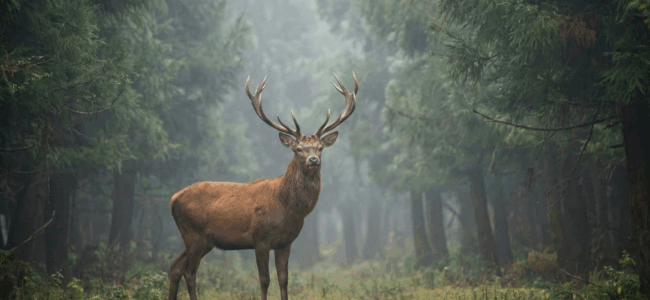
Once down to just 127 in 2007, the Valley’s iconic stag inches past 300, reviving hope for a species long feared lost
Our Special Correspondent
Srinagar: In the dense, frost-bitten forests of Dachigam, a quiet but powerful comeback story is taking shape. The Hangul—Kashmir’s iconic red deer and the only Asiatic survivor of the European red deer lineage—has begun to reclaim its presence after decades of decline, offering a rare note of optimism on the Valley’s environmental front.
Official data traces a sobering journey. In 1984, Kashmir supported around 556 Hanguls, spread across Dachigam and adjoining forest ranges. Years of habitat degradation, unchecked human interference, poaching, and prolonged instability took a heavy toll.
By 2007, the population had crashed to just 127, prompting experts to warn that extinction was no longer a distant possibility but an approaching reality.
Today, official estimates place the Hangul population at around 323 individuals, a slow yet significant recovery that conservationists describe as “hard-earned and fragile.” The revival is largely credited to intensified protection measures, scientific monitoring, and the Hangul Recovery Programme, which brought renewed focus to the species after its dramatic fall.
“This increase did not happen overnight,” said a senior Wildlife Protection Department official. “It is the result of years of habitat management, stricter anti-poaching enforcement, and limiting disturbance in critical breeding and wintering areas.”
More than 90 percent of the global Hangul population is now confined to Dachigam National Park, making it both a sanctuary and a point of vulnerability. Camera traps, periodic censuses, and field surveillance have improved population tracking, while efforts to protect migration corridors and calving grounds have helped boost fawn survival rates in recent years.
Wildlife experts, however, urge caution. “Three hundred animals is still a very small number for long-term genetic health,” said a biologist associated with Hangul monitoring efforts. “Any major shock—be it disease, climate stress, or renewed habitat pressure—could undo years of conservation work.”
Changing weather patterns, shrinking forest cover, and increasing human footprint around protected areas continue to pose challenges. Conservationists stress that expanding secure habitats beyond Dachigam and restoring traditional corridors is crucial if the species is to truly recover.
For Kashmir, the Hangul is more than a conservation statistic. It is a cultural symbol, deeply embedded in the region’s identity and folklore. Its cautious return from the brink stands as proof that sustained intervention can reverse ecological collapse—but only if commitment does not waver.
As the Hangul steps into a fragile revival, the message from experts is clear–survival has been secured for now, but the fight to ensure its future is far from over.
