
When the River falls silent: Jhelum’s fading pulse marks a snowless farewell to 2025
Minus flows, mounting pollution & a winter without snow leave Kashmir’s lifeline dangerously exposed
Our special correspondent
Srinagar: As 2025 slipped into history on December 31, the River Jhelum, Kashmir’s lifeline, delivered a stark and unsettling signal. At Sangam in south Kashmir — the river’s most critical hydrological gauge — the Jhelum was flowing at minus 0.71 feet, an extraordinary low for the heart of winter and a warning that the valley’s water system is under severe stress.
The year ends amid an unusual and worrying absence: the plains of Srinagar have yet to receive any significant snowfall. Winter, traditionally a season of replenishment, has so far failed to recharge the river, leaving the Jhelum thin, sluggish and visibly strained as it winds through the Valley.
Hydrologists say sub-zero readings at Sangam mean the river is flowing below its natural base level, drastically reducing downstream discharge. The impact is evident across the basin. At Ram Munshi Bagh in Srinagar, levels hovered just above 3.6 feet, while Asham in north Kashmir recorded barely 1.08 feet, far below seasonal norms. Several feeder streams, including the Lidder and Rambiara nallahs, have reported negligible to negative flows, further starving the main channel.
“This is not just a seasonal dip,” said Dr Farooq Ahmad, a hydrologist. “When a river records minus levels in December, it signals a breakdown in the recharge cycle. Delayed snowfall, reduced glacier contribution and rising temperatures are converging to weaken the Jhelum far earlier than expected.”
The absence of snowfall by the last day of December has heightened concern among farmers, environmentalists and water managers alike. Snowfall not only sustains winter river flows but also ensures groundwater recharge, spring revival and soil moisture ahead of the spring sowing season. With the snow still missing, natural springs across Pulwama, Shopian, Budgam and parts of north Kashmir have weakened or dried, raising fears of drinking water shortages in the months ahead.
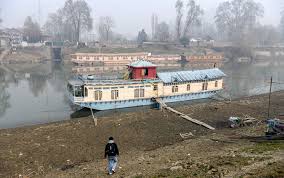
Along the embankments in Srinagar, the river’s retreat is impossible to ignore. Exposed sandbars, narrowed channels and low-drafted houseboats tell a quiet but powerful story. Elderly residents recall winters when snowfall arrived early and the Jhelum swelled steadily through December — a rhythm now increasingly broken. As flows shrink, pollution weighs heavier on the river.
Environmental assessments have shown elevated turbidity and biological oxygen demand (BOD) levels along several urban stretches, largely due to untreated sewage, plastic waste and agricultural runoff. With less water to dilute contaminants, pollution becomes more concentrated, threatening aquatic life and public health.
Encroachments along floodplains, narrowed channels and years of inadequate dredging have further reduced the river’s resilience. Experts warn that a weakened Jhelum is vulnerable at both extremes — unable to flush pollutants during dry spells and prone to devastation during sudden floods.
Climate scientists link the crisis to broader climate shifts–warmer winters, erratic precipitation and retreating glaciers that are steadily altering Kashmir’s hydrological balance.
“Rivers remember climate change long before people do,” Dr Ahmad added. “If these patterns persist, water stress will no longer be an exception in Kashmir — it will become the norm.”
As 2025 bids goodbye without snowfall in Srinagar and with the Jhelum flowing at minus levels, the river’s fading pulse reads like a warning etched in water — or the lack of it. Whether the coming months bring relief or reinforce this new normal will determine not just the fate of a river, but the future water security of Kashmir itself.
