
Jhelum Still Runs Thin despite Season’s First Snowfall
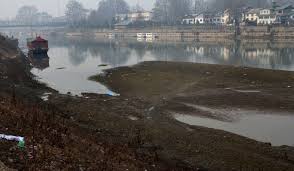
Snow on Peaks, Silence in the River
Light snowfall in Kashmir’s upper reaches brings winter cheer but fails to revive the lifeline river
Our Special Correspondent
Srinagar: Despite the season’s first snowfall blanketing Kashmir’s upper reaches and mountain passes, the Jhelum continues to flow listlessly through the Valley, its shallow channels reflecting a deeper environmental unease.
The sight of snow-draped peaks has offered visual comfort and hope, but on the ground—and in the riverbed—the impact remains negligible.
Hydrological data suggests that the snowfall recorded so far has been light and sporadic, insufficient to significantly recharge the vast catchment that feeds the Jhelum. At Sangam, the river’s primary gauge point, discharge levels remain well below the seasonal average, a trend mirrored at Srinagar, Asham and Baramulla.
Officials monitoring the river say that December snowfall, once a dependable precursor to gradual replenishment, has lost its reliability over the years.
Experts point to a troubling shift in winter patterns. Rising temperatures have shortened the snowfall window, while warmer nights are accelerating snowmelt before it can contribute meaningfully to sustained river flow. Studies indicate that average winter discharge in the Jhelum has declined by nearly a third over the past decade, a change increasingly linked to climate variability and reduced snowpack in the Pir Panjal and upper Himalayan ranges.
For farmers in south and central Kashmir, the river’s frailty is more than an environmental concern. Irrigation canals drawing from the Jhelum are already running low, sparking anxiety over rabi crops that depend on steady moisture through the winter months.
Urban water managers, too, are watching the trend closely, aware that prolonged low flows could strain drinking water supply schemes in Srinagar and adjoining areas.
Meteorological data shows that December has seen above-normal temperatures across much of the Valley, limiting snow accumulation despite snowfall in higher altitudes. Environmentalists warn that such winters—where snow arrives late, falls lightly and melts quickly—are becoming the new normal, altering the rhythm of rivers that once swelled predictably with the season.
All hopes now rest on January and February, traditionally the backbone of Kashmir’s snow economy. A sustained spell of heavy snowfall could still rebuild the snowpack and breathe life into the Jhelum. If not, experts caution, the consequences will ripple into summer, affecting agriculture, hydropower generation and drinking water security.
For now, as winter postcards frame white mountains against blue skies, the Jhelum whispers a quieter, more unsettling story—of a river waiting for snow that no longer behaves the way it once did.
