
Water sources in Kashmir under stress as experts rule out La Niña link
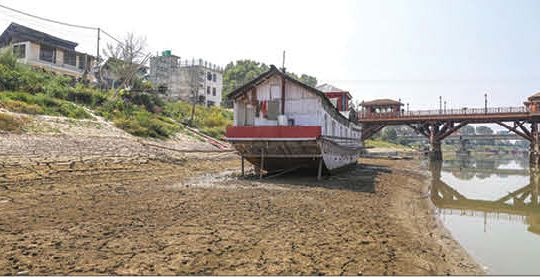
Prolonged dry spell driven by shifting weather patterns; La Niña not even declared officially
Srinagar: Kashmir is slipping deeper into a worrying dry phase, with major rivers and streams showing a steady fall in discharge levels through October and November — months when water bodies usually stabilise before winter sets in. Even as speculation grows among the public about a La Niña–driven winter, experts say the ongoing dryness has little connection to the global climate cycle, which hasn’t even been officially declared this year.
Independent weather forecaster Faizan Arif said the narrative linking Kashmir’s dry spell to La Niña is misplaced. He explained that the Pacific Ocean has not entered a La Niña state and that the Valley is currently experiencing conditions shaped by regional atmospheric behaviour rather than global oceanic patterns.
“We are still in an ENSO-neutral phase. Kashmir’s dryness is being caused by weak Western Disturbances and warmer layers in the upper atmosphere. La Niña is not a factor here,” he said.
Meanwhile, water levels across the Valley’s key rivers and tributaries continue to fall. The Jhelum at Sangam has already slipped close to its lower seasonal limit, while the gauge at Asham shows consistent decline. The Lidder in Pahalgam has thinned noticeably, exposing patches of its stony riverbed, and the Sindh in Ganderbal — crucial for both drinking water supply and hydropower canals — is flowing far below average.
The Vaishaw in Kulgam and Doodh Ganga in Budgam have also receded sharply, worrying both residents and the water supply departments. Smaller streams in Anantnag, Baramulla, and parts of central Kashmir are showing similar trends, forcing water schemes in some rural areas to shorten distribution hours.
A senior engineer with the Irrigation and Flood Control Department said the continuing depletion is “alarming but not entirely unprecedented,” adding that if December passes without significant rain or snow, the impact will be felt well into late winter and early spring.
He said that Kashmir’s water balance depends heavily on winter snowfall and that any delay affects the next agricultural season. Rain-fed belts have already begun reporting moisture deficits, and orchardists fear that inadequate early-winter precipitation may disturb chilling hours required for apple trees.
Experts say the broader issue is the shifting nature of Kashmir’s weather itself. A senior MeT official noted that Western Disturbances, which historically shaped the region’s winter rains and snowfall, are fewer and weaker, often dissipating before reaching the Valley.
He added that rising temperatures in the mid-troposphere are pushing moisture away, creating erratic winter behaviour. According to him, even if La Niña develops later, its impact on Kashmir may not resemble past patterns due to climate-driven changes in the Himalayan region. “The Himalayas are responding more to long-term warming than to traditional ENSO cycles,” he said.
Residents across the Valley say the changes are visible on the ground. In Pahalgam, villagers point to the unusually shallow Lidder. In Kulgam and Budgam, people say the Vaishaw and Doodh Ganga now resemble late-spring streams rather than early-winter rivers. “We haven’t seen such low flow in November in many years,” said Zahoor Ahmad of Pahalgam. “Everyone is praying for snow. Only that will bring our waters back.”
As Kashmir enters what used to be its snow-rich season, the absence of precipitation has created unease among farmers, hydropower managers, and ordinary households. For now, experts maintain that Kashmir’s shrinking water sources are being shaped by shifting local weather patterns and a warming climate — not by La Niña.
