
Karwa Chauth: Between tradition, love and patriarchy
Dr. Priyanka Saurabh
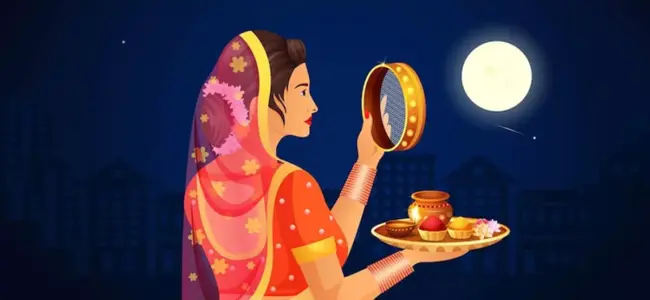
Every year, on the Chaturthi of the month of Kartik, as the evening sun sets, well-dressed women across India gaze at the moon, adorning plates with lamps, sieves, and karwa (water pots). Red bindis adorn their foreheads, henna on their hands, anticipation in their eyes, and a single question on their lips—“Did the moon rise?” This scene both symbolizes the beauty of Indian culture and reflects its deeply held social meanings.
The Karva Chauth fast is celebrated with great enthusiasm in North India, especially in Punjab, Haryana, Rajasthan, Delhi, Uttar Pradesh, and Bihar. On this day, married women observe a waterless fast from sunrise to moonrise, praying for the long life of their husbands.
According to tradition, this fast is observed for the stability of their marital life and the long life of their husbands. After a day of austerity, when the moon rises, the wife breaks the fast by looking at her husband’s face through a sieve.
But the question arises whether this fast is just an expression of love and faith or a symbol deeply rooted in the patriarchal roots of society?
In Indian society, a woman’s life is linked to her “marriage”—her happiness, her reputation, and even her identity. After marriage, her husband was considered the greatest achievement of her life, and his death was considered a curse.
Thus, fasts like Karva Chauth became celebrations of a woman’s dedication, sacrifice, and tolerance. But is this a celebration of love or a cultural justification for tying a woman’s existence to her husband’s age?
When today’s educated women observe the Karva Chauth fast, the reasons may not be traditional. For many women, it has become a symbol of love for their husbands, of companionship, and of harmony in their relationships.
Many men are also now observing the fast with equal devotion to their wives—a positive change. But it’s equally true that Karva Chauth has become a “cultural event”—the more “glamorous” it is portrayed in TV serials, films, and social media, the more deeply its original meaning is being lost.
This fast was once a symbol of closeness and cooperation among village women. Women would visit each other’s homes, fill earthen pots with water, and sing songs like, “its Karwa Chauth’s fast, brother, don’t forget to bring the Karwa.”
This festival was an occasion for them to come together, where they would share life’s hardships. But now, this fast has become a display of gold pots, expensive jewelry, and designer sarees. Instead of fasting, it’s the era of “Insta Reels”—where adornment has become the main objective.
Nevertheless, it’s not right to dismiss traditions as mere superstitions. Every culture has its own soul. The spirit behind Karva Chauth—love, devotion, and faith—cannot be ignored. But it’s also important to view the tradition from a modern perspective. Today, when we talk about equality, freedom, and mutual respect, this fast should not be one-sided. If a wife fasts for her husband’s long life, the husband should equally pray for his wife’s happiness, prosperity, and health—this is true love and equality.
Interestingly, the religious or mythological basis of Karva Chauth is not as clear as the influence of its popular practice. “Karva” means an earthen pot, which symbolized water in ancient India, and “Chauth” means the day of the fourth day.
Some scholars believe that this fast was linked to the tradition of military families—when husbands went to war, wives observed this fast for their safe return. Other beliefs say that it was a means of increasing social unity among women. This means that the core of this festival was not only related to the husband’s longevity, but also to the social contribution of women.
In modern society, Karva Chauth has many interpretations. On the one hand, it is a celebration of love, while on the other, it is also a societal pressure on women to be the “ideal wife.” This contradiction forces us to ponder—is every love measured by sacrifice? Is true loyalty proven only through fasting? And has this tradition become a celebration of the equal relationship between husband and wife, or is it still a symbol of “husband dominance”?
Still, it’s true that its form has changed over time. In many places, husbands also observe the fast, and many couples celebrate it as a “relationship ritual.” This shift indicates that society is gradually moving toward equality. The meaning of the festival remains the same, but the perspective has changed. The same is true of Karva Chauth—where it once symbolized a woman’s duty, it is now embodying a shared relationship.
Today, we need to strike a balance between tradition and modernity. Karva Chauth should neither be seen as merely a ritual nor a festival of mere show. Embrace its true love, emotion, and dedication—without any societal pressure. Every woman should have the right to choose whether to fast or not; because love is defined not by fasting, but by mutual understanding and respect.
If through this fast, husband and wife can get an opportunity to understand each other, appreciate each other’s sacrifices and bring newness in their relationship – then this festival will be successful in its true sense.
Because after all, Karva Chauth is not just a festival of “long life of husband”, but it symbolizes the stability and sensitivity of the relationship that connects two souls.
(The author is a Research Scholar in Political Science, Poet and a freelance journalist)
