
Kashmir’s Paddy Miracle: Bumper Harvest Defies September Deluge, Heat Wave
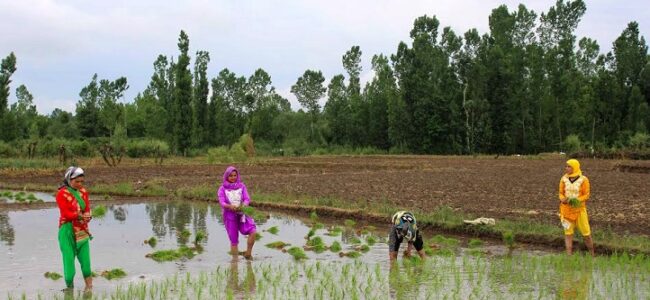
Valley records highest yield in years; farmers hail new SR-4 seed, official’s project 10 lakh MT output
By: Our Special Correspondent
Srinagar: Kashmir has pulled off a rare agricultural triumph this autumn. Despite the September deluge and earlier heat wave that threatened devastation, the Valley is witnessing a bumper paddy harvest, with officials projecting production could touch 10 lakh metric tonnes — the highest in years. Last year, output stood at just 8.2 lakh metric tonnes.
From Pulwama’s lush plains to Budgam and Ganderbal’s fertile stretches, fields that were once submerged now glisten with golden grain. Farmers who braced for ruin speak of relief and astonishment. “We thought everything was gone when our fields lay under water for days in September. But the yield is even better than before. This feels like a miracle,” said Abdul Rashid, a farmer from Chadoora, Budgam, as he bent to feel the heavy rice panicles.
Rice is Kashmir’s lifeline, cultivated on nearly 1.4 lakh hectares of land and contributing more than 70 percent of the local cereal intake. The Valley’s annual requirement is around 9–10 lakh metric tonnes, and for rural families, paddy is not just food but livelihood, security, and identity. Traditionally vulnerable to rainfall patterns, this year’s crop withstood punishing extremes, turning what could have been a disaster into an exceptional harvest.
Much of the credit, experts say, goes to Shalimar Rice-4 (SR-4), a high-yielding variety developed by SKUAST-K that has shown remarkable tolerance to stress conditions. “SR-4 has changed our fortunes. Even after floods, my harvest nearly doubled,” said Ghulam Nabi, a Pulwama farmer. An agriculture officer, unwilling to be named, confirmed, “Where SR-4 was adopted and drainage ensured, yield has been extraordinary. It’s not uniform, but overall the Valley has gained.”
Ironically, the September floods did leave scars. In Anantnag and Kulgam, entire belts of paddy were flattened and washed away.
“For us there is no bumper harvest — only loss and debt,” lamented Javaid Ahmad, a farmer from Kulgam, his fields still bearing the marks of floodwater.
Still, granaries across much of the Valley are filling fast. In villages spared the worst, the mood is buoyant. “Rice is our life. After the September deluge, to see this bounty feels like God’s blessing,” Abdul Rashid said, as neighbours stacked golden sheaves under a mellow autumn sun.
Agriculture experts caution that such resilience cannot be taken for granted. They urge climate-resilient seeds, stronger drainage systems, and scientific practices to safeguard future harvests in a Valley increasingly at the mercy of extreme weather. For now, however, Kashmir’s farmers can breathe easy: a golden harvest has risen from floodwaters, turning fear into relief and despair into hope.
