
Kashmir’s Saffron dream wilts as land shrinks, experts doubt ‘Bumper Crop’
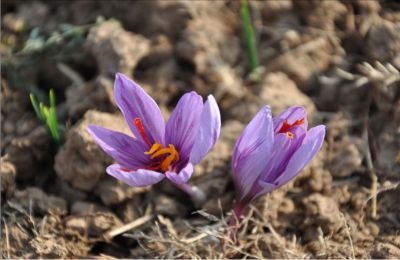
By: Our Special Correspondent
Srinagar: Once hailed as the pride of Kashmir, the valley’s world-famous saffron fields are shrinking rapidly, casting doubt over hopes of a bumper harvest this season. From nearly 5,700 hectares under cultivation in the late 1990s, the crop now survives on just about 3,700 hectares, official data reveals.
Annual production, which touched nearly 16 metric tonnes in 1997-98, has plunged to barely 2.6 metric tonnes in 2023-24. Farmers and experts warn that despite government interventions under the National Saffron Mission (NSM), the declining land and erratic weather make a substantial rebound unlikely.
“We used to produce more than 8 metric tonnes in 2010-11. Last year, we barely managed a third of that,” said Abdul Hamid, a grower from Pampore, the saffron town of Kashmir. “This dry spell has hit us hard, and the crop production is expected to be less than half of what it was in previous years.”
Another farmer, Shabir Ahmad, lamented that even rejuvenated fields were struggling. “Sprinkler irrigation systems were installed, but many are defunct. Without water, how can saffron survive?” he asked.
Agriculture scientists echo these concerns. “Dry conditions due to climate change have certainly resulted in low yields,” said a SKUAST-K scientist. “But the lack of interest in saffron farming has also potentially hit the future of a cash crop that has brought wealth to the region for 2,500 years.”
Officials, however, remain cautiously optimistic. “In the rejuvenated plots, yields have touched 4.5–5 kg per hectare, which is a significant improvement compared to past years,” said an officer from the Agriculture Department. “If favourable weather continues, we may see better output than last year, though a bumper crop is unlikely.”
Experts point out that the crisis is not just about weather but also about land-use changes. Much of Kashmir’s saffron belt, especially Pampore, has witnessed unplanned residential and commercial construction. “We are not only losing a heritage crop but also eroding the cultural identity of Kashmir,” said social activist Ghulam Qadir.
According to official surveys, more than 2,000 hectares of saffron land have been lost in the past two decades. Farmers say that lack of strict regulation has encouraged encroachment, while higher land prices for construction have tempted some growers to sell their fields.
Economists warn that saffron’s decline carries larger implications. “Saffron is not just a crop; it is an economic and cultural asset. Its decline directly impacts livelihoods and the brand value of Kashmiri exports,” noted Prof. Naseer Ahmad, an agricultural economist at Kashmir University.
The valley’s saffron enjoys a Geographical Indication (GI) tag, making it globally recognised for purity and flavour. Yet, low yields have opened the door for Iranian saffron to dominate Indian markets. “Demand for Kashmiri saffron is huge in Delhi and Mumbai, but when supplies fall, cheaper Iranian saffron takes over our markets,” said Mohammad Ashraf, a trader from Srinagar. “If production does not stabilise, Kashmir could lose its competitive edge.”
The government insists that revival remains a priority. Under the NSM, thousands of hectares have been rejuvenated with improved corms and irrigation systems. Officials say a dedicated monitoring mechanism is in place to ensure better yields in the coming years.
Still, growers say more needs to be done. “We want the government to repair the non-functional irrigation systems, control construction on saffron land, and provide incentives that make saffron farming viable again,” said farmer Abdul Rashid.
For now, hopes of a bumper saffron harvest remain dim, with growers and scientists warning that without sustained policy support, effective irrigation, and strict land-use regulation, the valley’s ‘red gold’ could continue its downward spiral.
